

HISTORY
FROM OKLAHOMA ACORN TO TEXAS OAK
THE STORY OF BRANIFF AIRWAYS
by Richard Benjamin Cass
Two brothers, a dreamer and a pragmatist, joined forces to create one of the world's leading airlines, Braniff Airways. From humble beginnings that began as an Aero Club in Oklahoma City in 1927, Braniff grew to become a multinational corporation that flew throughout the Continental United States, Canada, Mexico, from the U.S. Mainland to South America, and across both the Pacific and the Atlantic. Those brothers, Paul Revere Braniff, the dreamer and aviator, and Thomas Elmer Braniff, the pragmatist who had already created a burgeoning insurance empire, had the courage and foresight to become early pioneers in America's burgeoning aviation industry.
Their first venture, Paul R. Braniff, Inc., formed in the spring of 1928, took to the air on its maiden flight on June 20, 1928 with a single 5 passenger single engine Stinson Detroiter. The new airline flew oil company executives between Oklahoma City, Oklahoma, where Braniff was based, to Tulsa, Oklahoma, the heart of the Oklahoma oil boom. The airline was completely dependent on passenger fares for its existence. A large aviation holding company that was hoping to build an air and rail network from coast to coast purchased Paul R. Braniff, Inc., in 1929 and in 1930 the company was absorbed by the successor to American Airlines.
The brothers, now with aviation mixed in their blood, once again joined together to create the airline company that would eventually span the globe, Braniff Airways, Incorporated, in November 1930. Once again, the new company was dependent on passenger fares for its continued operation and with the country in the throes of the Great Depression finding passengers with money to fill their Lockheed Vega aircraft was not a small task.
The airline was close to collapse when in 1934 it was awarded its first airmail contract between Chicago and Oklahoma City. Government corruption brought a saving grace to Braniff and the rest of the fledgling airlines that traversed the United States. Braniff Airways now had the support of not only passenger fares but also guaranteed air mail payments that virtually guaranteed its existence.
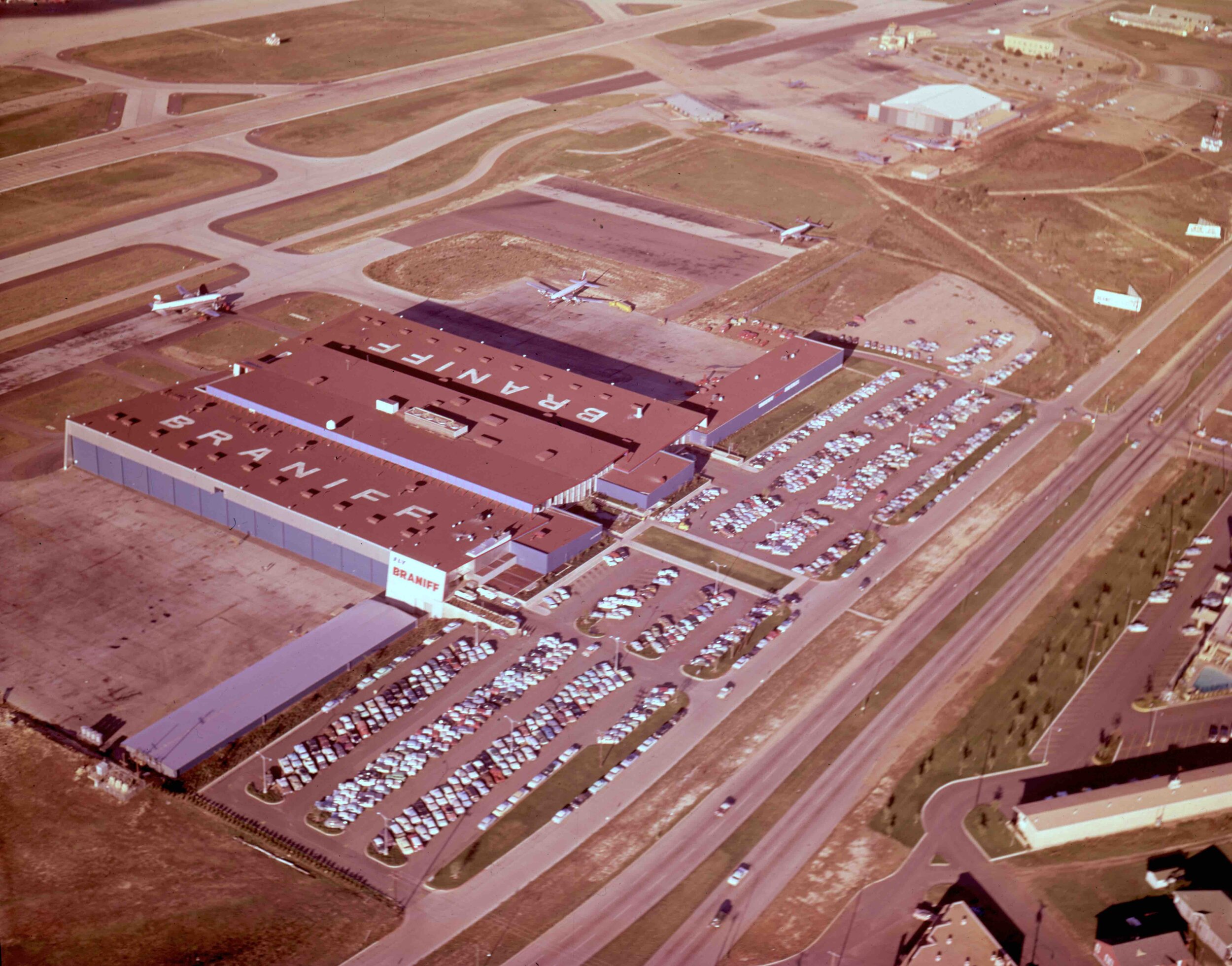
The company began a steady growth while becoming the surviving carrier after merging with two small airlines that further increased the size of its route system while strengthening its airmail payments by adding new postal routes. By 1940, the carrier had upgraded to the ubiquitous 21 passenger Douglas DC-3 twin engine airliner that revolutionized the entire airline industry and overnight made it a safe and reliable method of transportation. The airline moved its headquarters to Dallas Love Field by the summer of 1942 that had become the central terminus of its core operations, which linked the Great Lakes to Texas. Braniff's growth, along with the rest of the industry, was slowed by the global war which required the assets of nearly every company in the United States and that specifically included the troop carrying capacity of passenger aircraft.
After the War, Braniff's fortunes would only explode with the company receiving approval to operate between the US Mainland and Central America, Cuba, and deep into the South American Continent. Large four engined Douglas DC-4 and DC-6 airliners were added to the fleet and were specifically purchased for operation over the company's 7000-mile route system south of the border and International script was added to the corporate masthead in 1946. Service began from Dallas to Cuba, Central America and South America on June 4, 1948 and with that little Braniff Airways became an international airline of sizable measure. Strangely, Braniff would not be authorized to serve Mexico until the 1960s, although Tom Braniff had operated a small Mexican airline, Aerovias Braniff, during 1945. Because of inter-governmental disagreements stemming from Aerovias Braniff, Braniff Airways was denied the chance to link the United States with its neighbors to the South.
Braniff continued to expand its South America route system into the early 1950s but costs caused the need for greater subsidy to ensure the airline wasn't losing money, which could affect its domestic operations. The Latin America Division or LAD, officially never made a cent until 1965. The airline grew again by merger with a small Mid-west carrier, Mid Continent Airlines, based in Kansas City, in August 1952. The untimely loss of Braniff's President, Tom Braniff, in a private plane crash in January 1954 saw the first change in management since 1935 when Paul Braniff left the company to pursue other ventures. An able manager, Charles Edmund Beard was hired as his replacement with Mr. Beard assuming most of Paul's duties. It was Charles Beard who stepped forward to graciously accept the helm in January 1954 now that the company's cherished co-founder was gone.
Charles Beard successfully flew Braniff into the Jet Powered age in 1959 with the introduction of the Lockheed L-188 Electra four engine turboprop followed by the pure jet Boeing 707 in December 1959. The airline had expanded operations across the Eastern United States to Newark and Washington DC and via an Interchange with Eastern Airlines through Miami which served as another gateway to feed the company's South America system. Earlier in the 1950s, Beard had proposed merging Braniff with Pan American Grace Airways, the largest U.S. airline operating in South America but resistance by the airline's half owner, Pan American, had scuttled the merger until 1967.
After the death of Mr. Braniff, followed by his wife Bess in August 1954 the ownership of the airline was left to the Blakley/Braniff Foundation. In the early 1960s, the company was sold to a group of Texas Instruments executives and in 1964, it was sold again to Greatamerica Insurance Company. The executives of Greatamercia had identified Braniff as a well-run and stable company but a highly underutilized operation that could, with an overhaul, become a world-class airline that might span the globe. The Greatamerica management was correct and in less than two years Braniff became the talk of the town and assumed the throne as the king of promotion.
Charles Beard announced his intention to retire from Braniff in November 1964 and a search commenced for a new leader. A leader and a maverick was found in a young Continental Airlines Executive Vice President, Harding Luther Lawrence, who was responsible for mastering 500 percent growth at the small trunk airline in the ten years, he was with the airline all the while being tutored by the magnificent Robert F. Six. At 44 years of age, Lawrence was one of the youngest airline CEOs in the country. He began looking over the Braniff operation in February 1965 by visiting every area of the company while taking extensive notes. He was ready to reform Braniff in April 1965 when he assumed the presidency.
Harding Lawrence demanded that a new promotion and advertising program be designed to catapult Braniff into the world spotlight in a very short period of time. To help with this, he hired the New York advertising think tank of Jack Tinker and Partners, employer of Mary Wells, who had made a name for herself on Madison Avenue. Mrs. Wells created a campaign that revolutionized the entire way that airlines presented themselves to the public. The End of the Plain Plane Campaign introduced the airline world to Alexander Girard who designed over 17000 public contact items and Emilio Pucci who designed a space age themed couture uniform for ground and flight personnel. Girard designed an amazing palette of bright and vibrant colors that were painted on Braniff's jet aircraft along with corresponding interiors with bright and colorful seat fabrics. Flying on Braniff was stylish and exciting and the rest of the industry followed.
The public took notice and applauded Braniff's end to the military themed presentations that had been an airline hallmark since their founding. With this, Braniff began a non-stop period of record growth in traffic and profits for the next 14 years. The company began flying to Hawaii in 1969, which caused the need for a new Boeing 747 that was delivered in January 1971 and painted bright orange. It became the flagship of the fleet and would fly the airline's inaugural flight to London in 1978, the airline's 50th anniversary year, after a two-decade fight to win the authority to fly across the Atlantic.
Alexander Calder was hired in 1972 to paint a full sized McDonnell Douglas DC-8, which became the world's first flying canvas and he repeated the performance again for America's Bicentennial in 1976. New vibrant color schemes were added during the 1970s and Halston designed an amazing line of easy to wear-and-care ground and flight personnel uniforms.
The Airline Deregulation Act was signed into law in the fall of 1978 and few airlines had any strategy for competing in a non-regulated environment except for Braniff. The company's management felt that the only way for Braniff to survive was to grow and become strong because in the end only a small number of large legacy carriers would survive. Braniff took immediate advantage of the new world by adding additional routes and cities as well as aircraft but also increased aircraft daily utilization significantly to meet the demands. Many of the international routes that Braniff had applied for as far back as ten years earlier were now being awarded and at the behest of the Civil Aeronautics Board, the company began expanding its European service in the summer of 1979 and by the fall the new orange 747s were crossing the Pacific linking Asia, Pacific and The Far East, with South America.
Harding Lawrence had transformed Braniff once again and was being hailed as the last airline maverick. A new color scheme adopted in 1978 featured deep dark and elegant solid colors with warm light brown leather interiors. The new look embodied the maturing of Braniff International into a truly world class airline. However, the global and U.S. economic conditions exacerbated by foreign oil markets would not allow Braniff to enjoy its newfound prominence. Virtually, as Braniff began its well-planned expansion, unrest in Iran created a crisis that caused oil prices to explode to unprecedented levels from 1979 through 1981. Changes in the Federal Reserve's monetary policy in 1979 caused interest rates to rise to double digit levels just as Braniff's sparkling new Boeing 727s and Boeing 747s were rolling off the line to meet the demands of the company's impressive route system and giant mega competitors that had been kept at bay in a regulated environment were invading Braniff’s system at a shocking rate (Braniff’s Houston to Dallas route featured an 89-percent market share and was shared with only one other carrier but by 1981, Braniff’s market share had plummeted to 18 percent and the market was now shared with six airlines and this became common throughout Braniff’s route system). Braniff was flying into a storm that no one in the industry except for a confirmed Cassandra believed could ever happen.
Braniff survived for another two years after Harding Lawrence retired in December 1980. In early 1980, he began an immediate program to turn the airline around which called for reducing capacity by selling unneeded older aircraft and eliminating routes that were now unprofitable because of the prevailing economic conditions. The plan was working and Braniff was poised to ride out the downturn by 1981 or sooner. Braniff continued to be fraught with unbelievable circumstances arising from the beginning of a severe U.S. recession that began in the summer of 1981. Decisions were being made at the company's sleek corporate headquarters on the west side of DFW Airport that led to the company's eventual end of flying operations (all company subsidiaries continued in operation for many years) in May 1982.
Braniff would fly again in March 1984 but with a return to the military style presentation that it had fought so hard to shed. In spite of the loss of the industry's high flying darling, the legend of Braniff continues forward today because of its deep associations with the art, fashion, and design industries. It is because Braniff brought together the mystery and intrigue of aviation with these exciting industries that the airline is still in the public conscience today and will always be remembered and admired by future generations.