
Braniff Airways Timeline 1880 to 1939
BRANIFF AIRWAYS, INCORPORATED TIMELINE

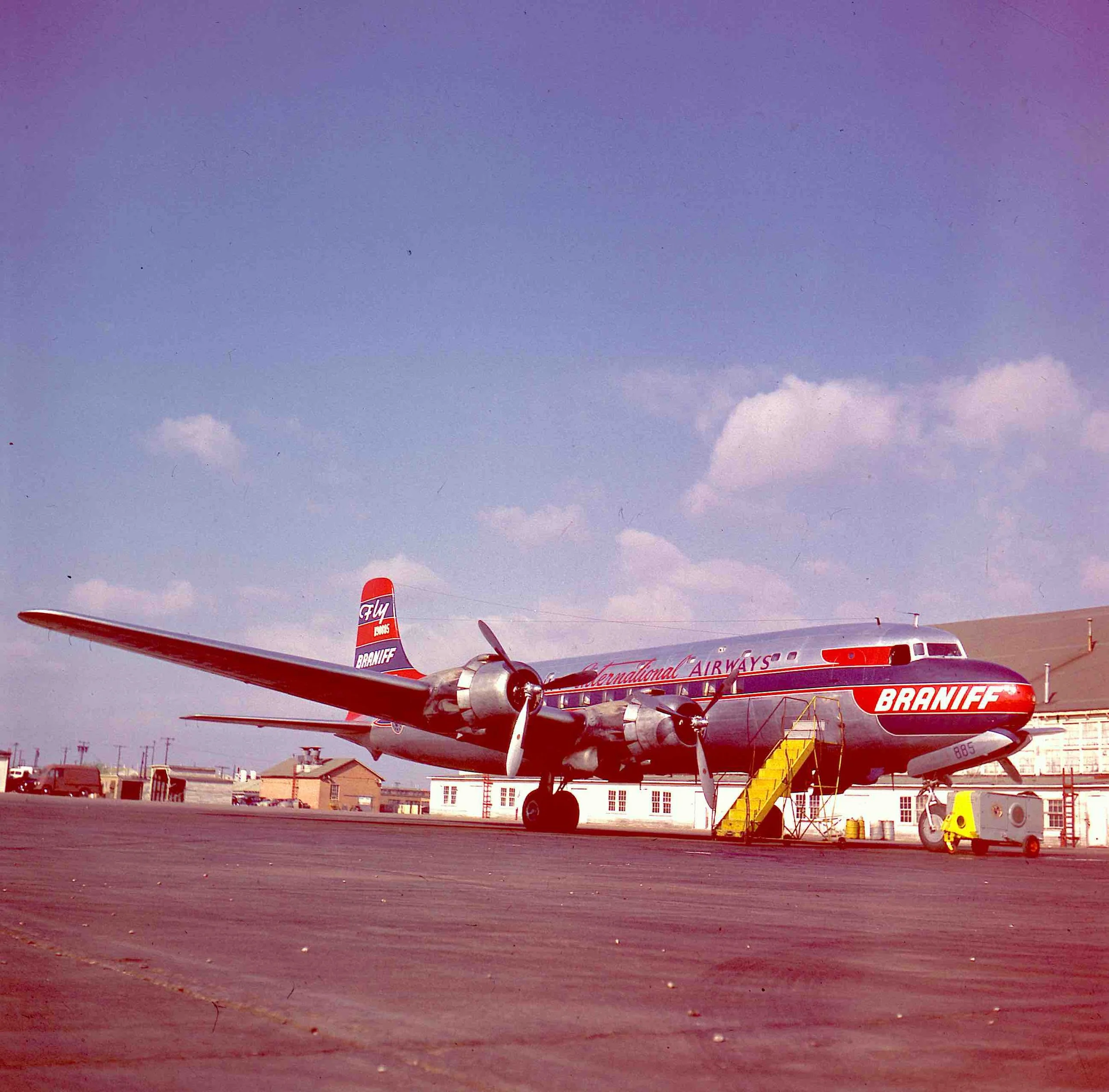

1880 to 1889
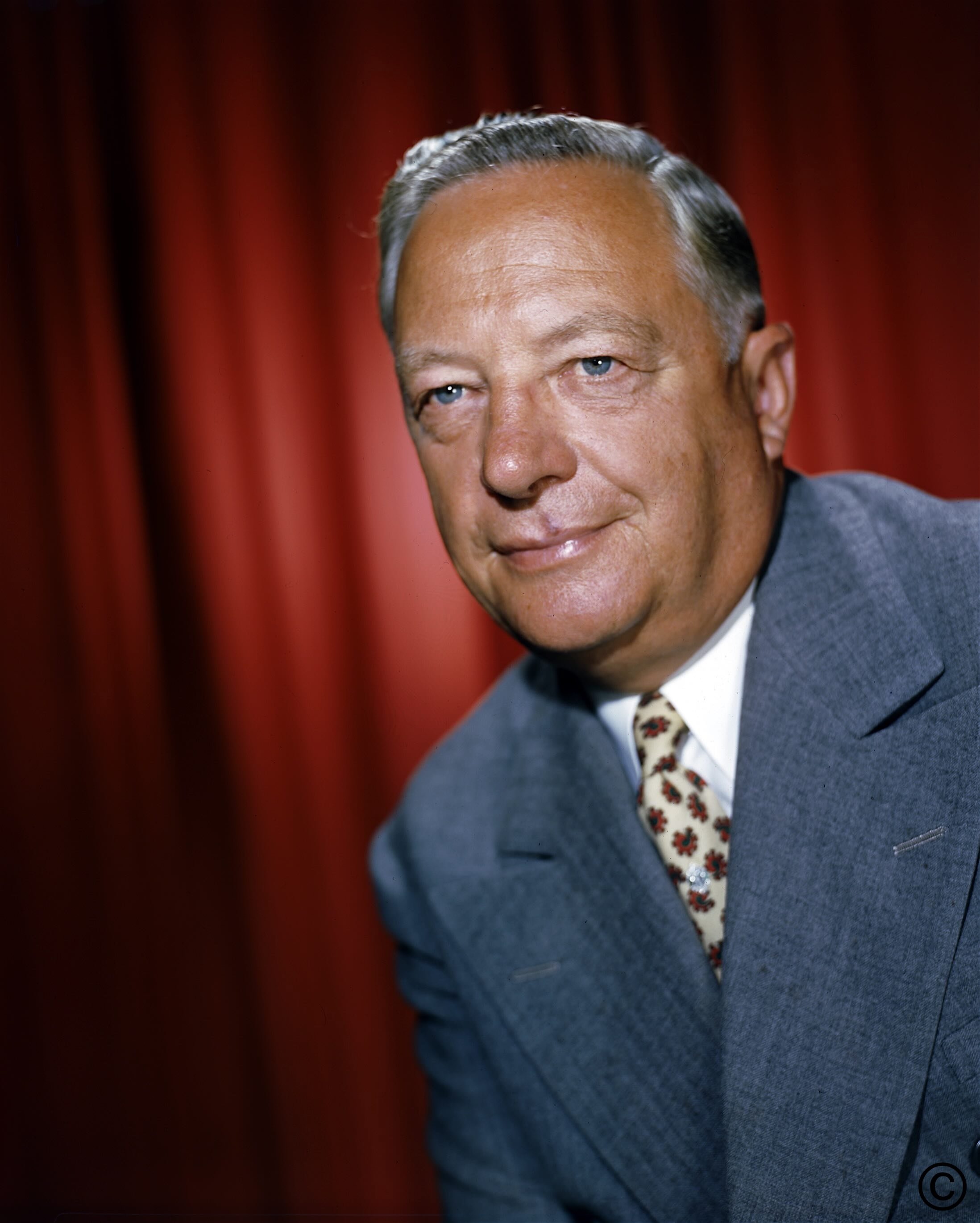
December 6, 1883
Company co-founder and insurance business entrepreneur Thomas Elmer Braniff is born on this date in Salina, Kansas
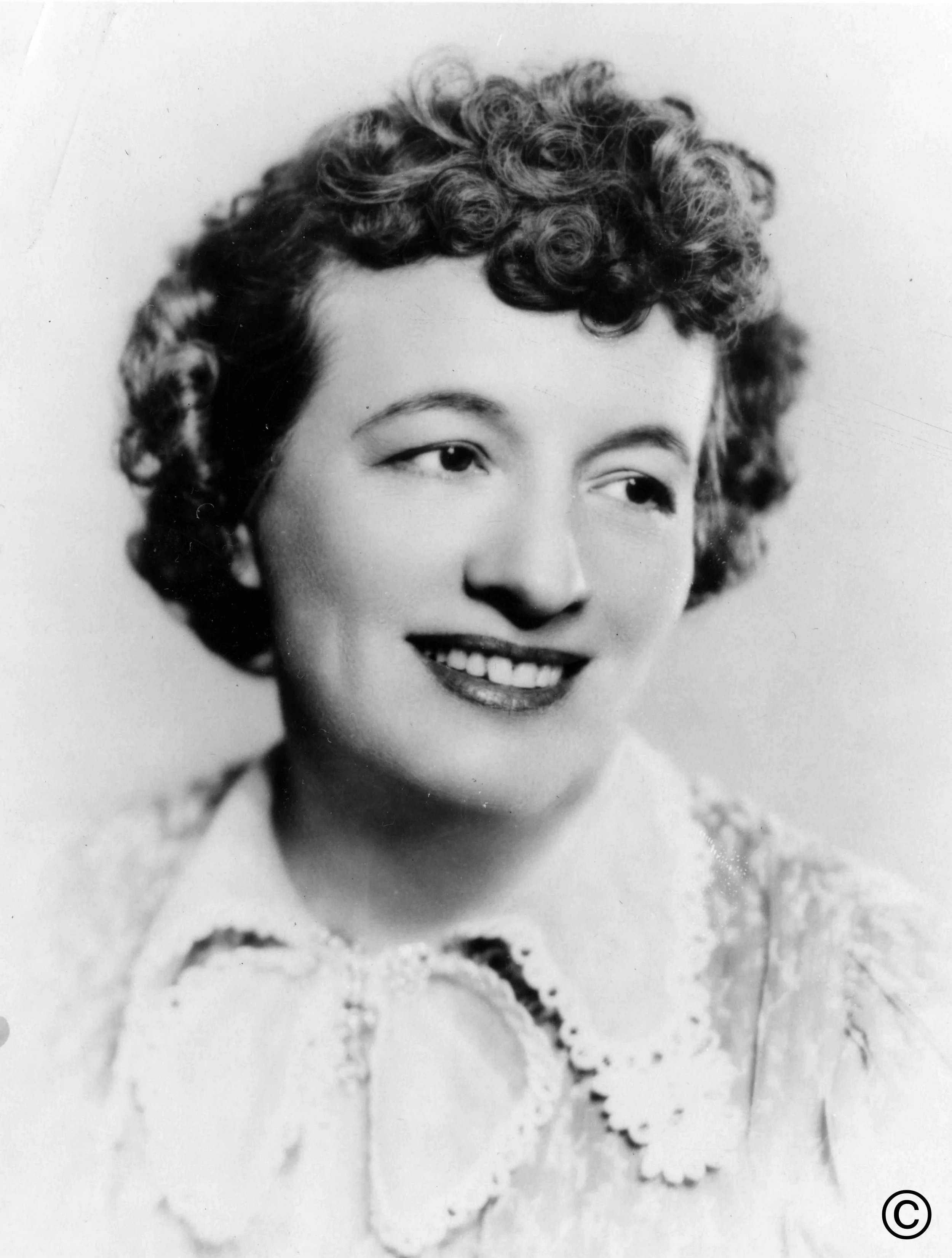
July 25, 1887
Bess Thurman Braniff is born on this day and marries company co-founder Thomas Elmer Braniff. Her brother is Hal Thurman, a judge in Oklahoma City, who later served as Braniff’s chief counsel
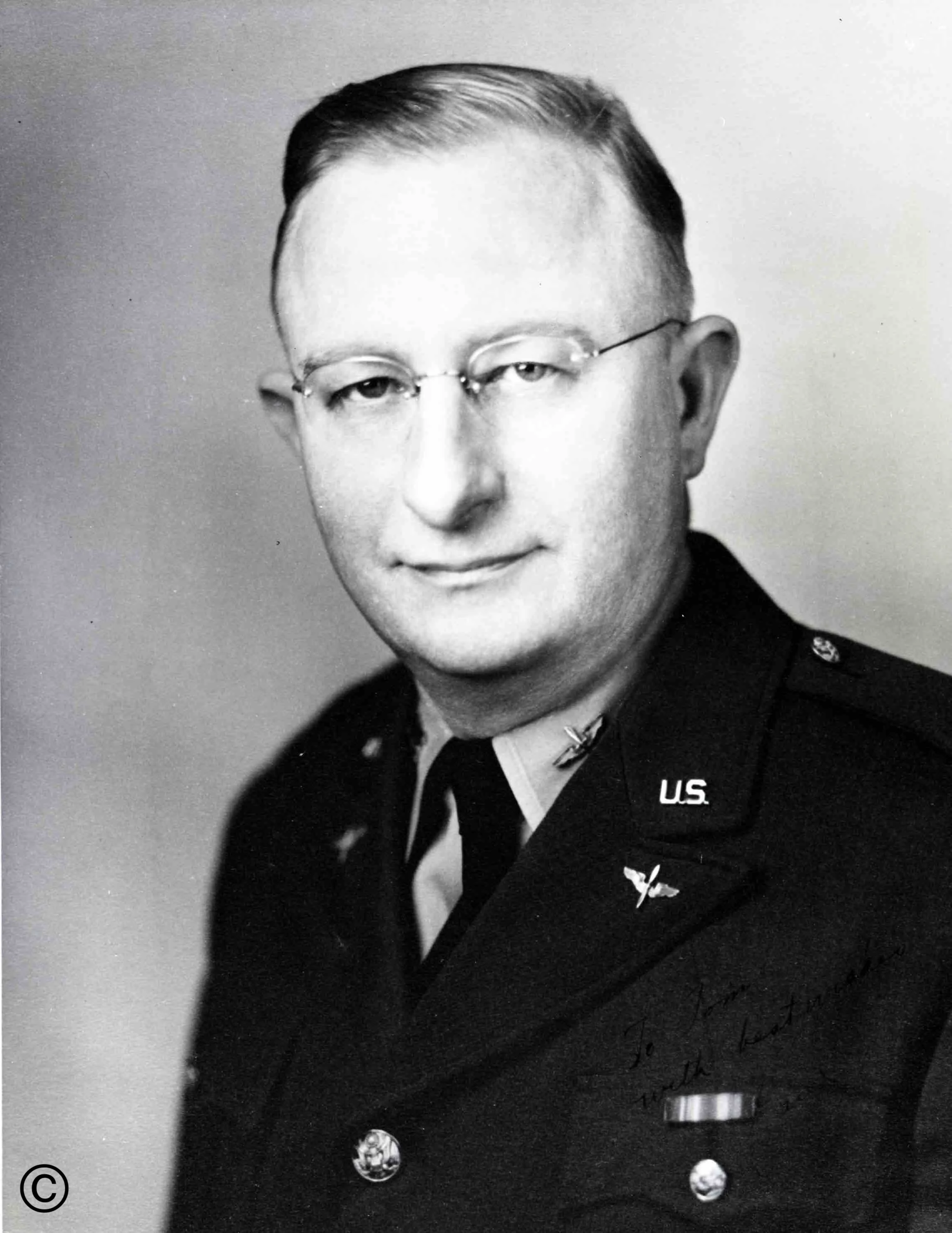
August 30, 1897
Company co-founder Paul Revere Braniff is born on this day in Kansas City, Missouri
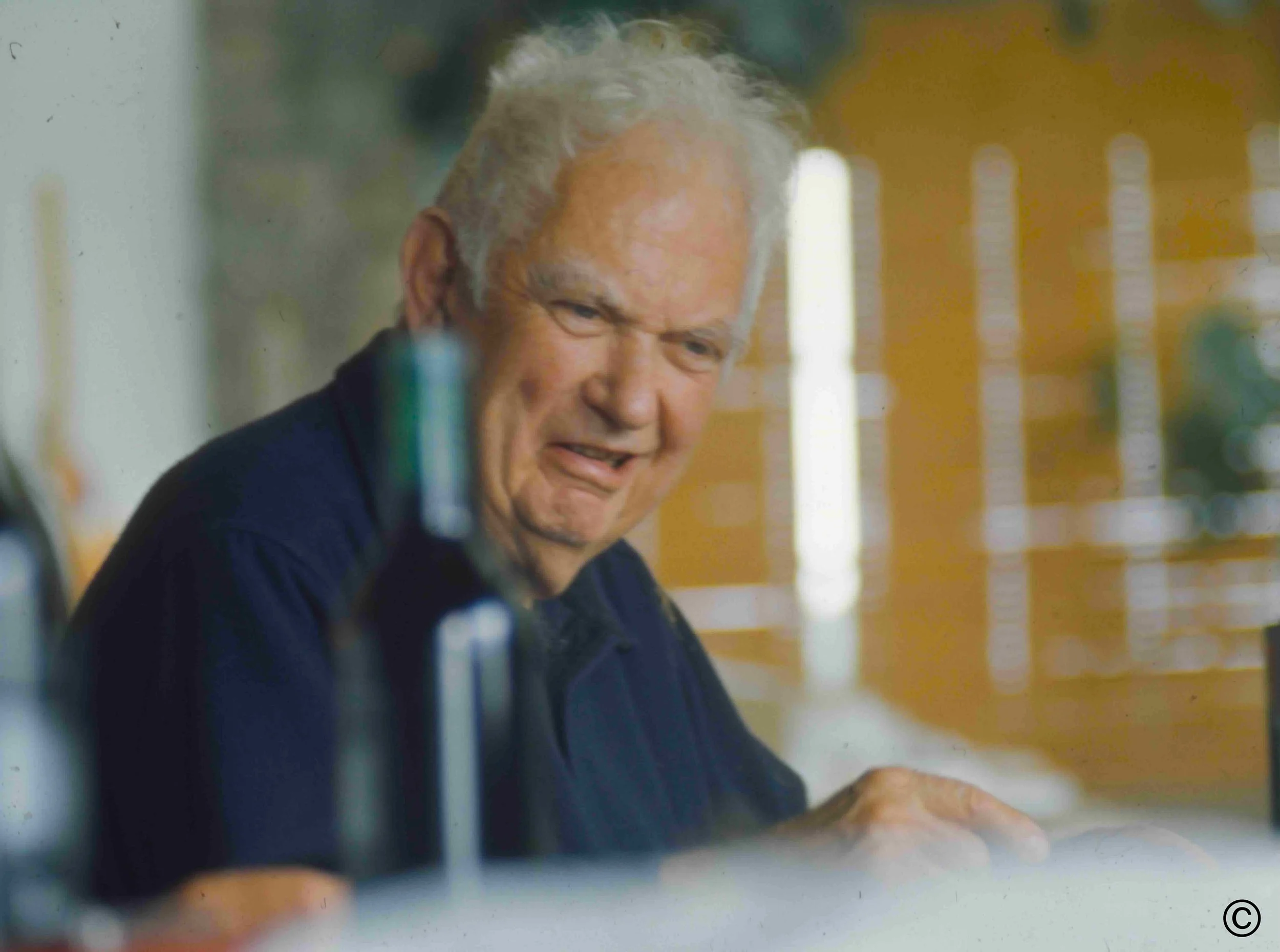
July 22, 1898
Alexander “Sandy” Calder, who made art history by painting two Braniff jetliners in unique color schemes that he designed, was born on this date
1900 to 1909
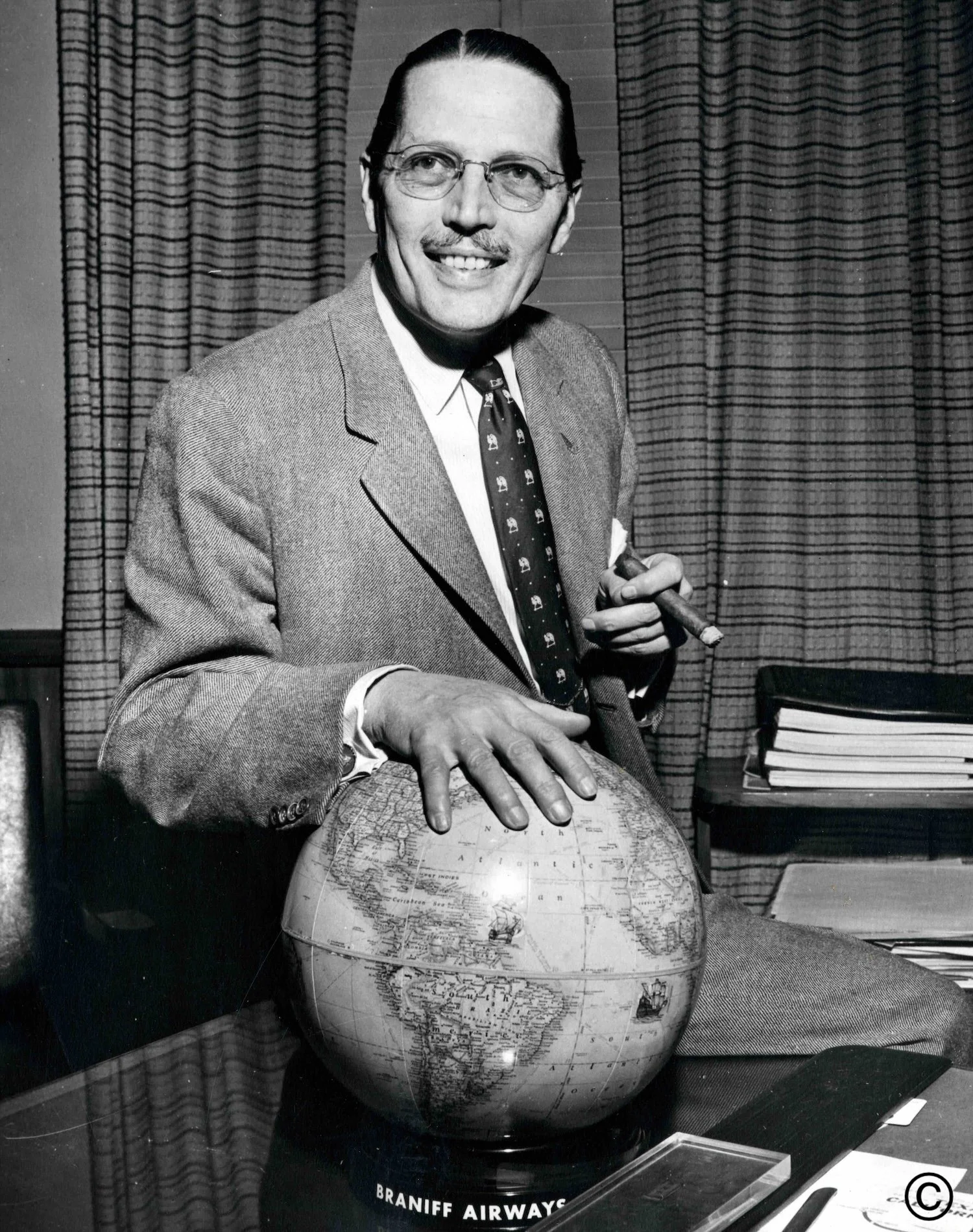
November 23, 1900
Charles Edmund Beard is born on this date. Mr. Beard joined Braniff as general manger in 1935 and became president in 1954
1910 to 1919
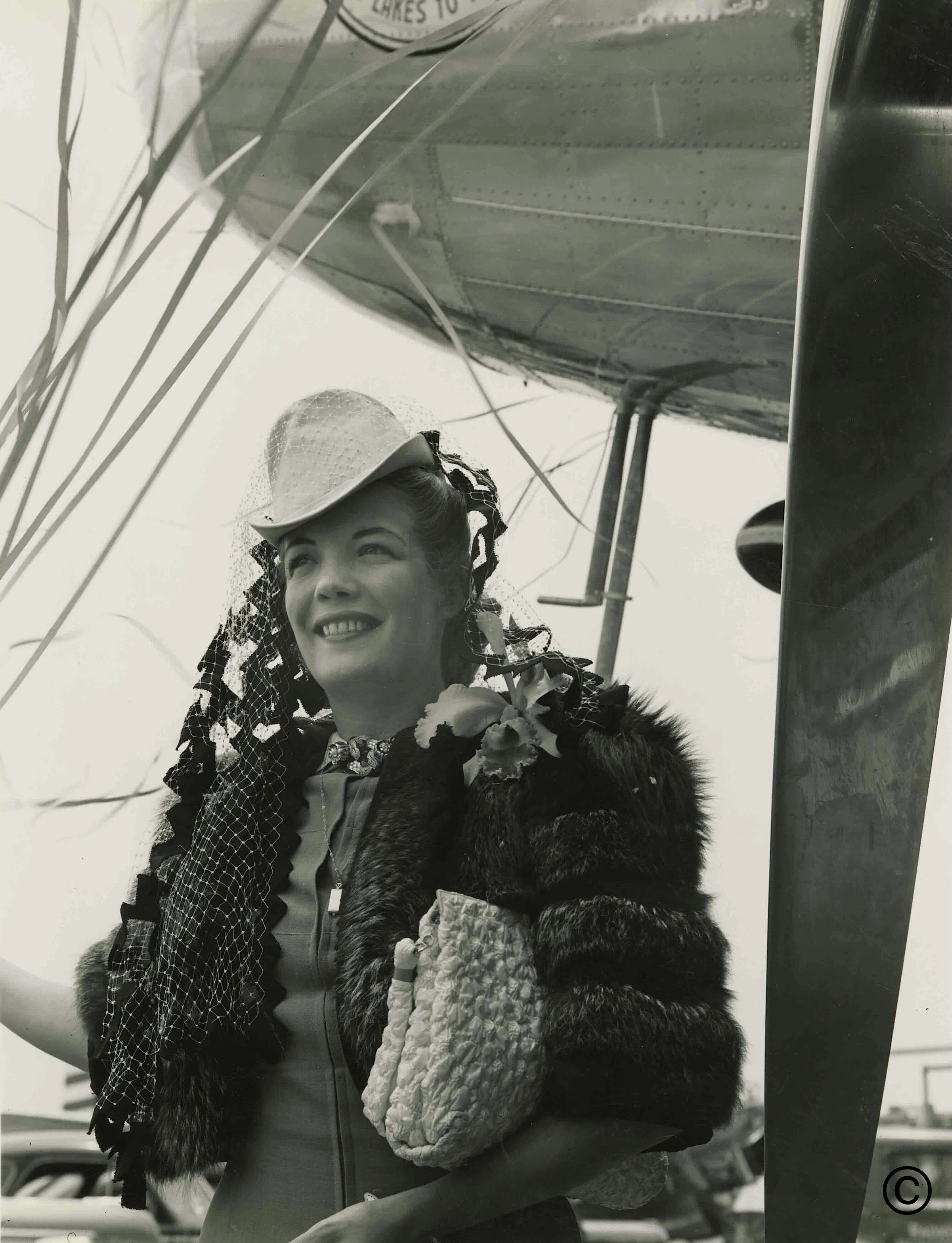
October 5, 1914
Jeanne Braniff Terrell, the only daughter of company co-founder Thomas Elmer Braniff and his wife Bess Thurman Braniff, designed beautiful bulkhead designs for Braniff’s aircraft and also designed the company’s hostess uniforms
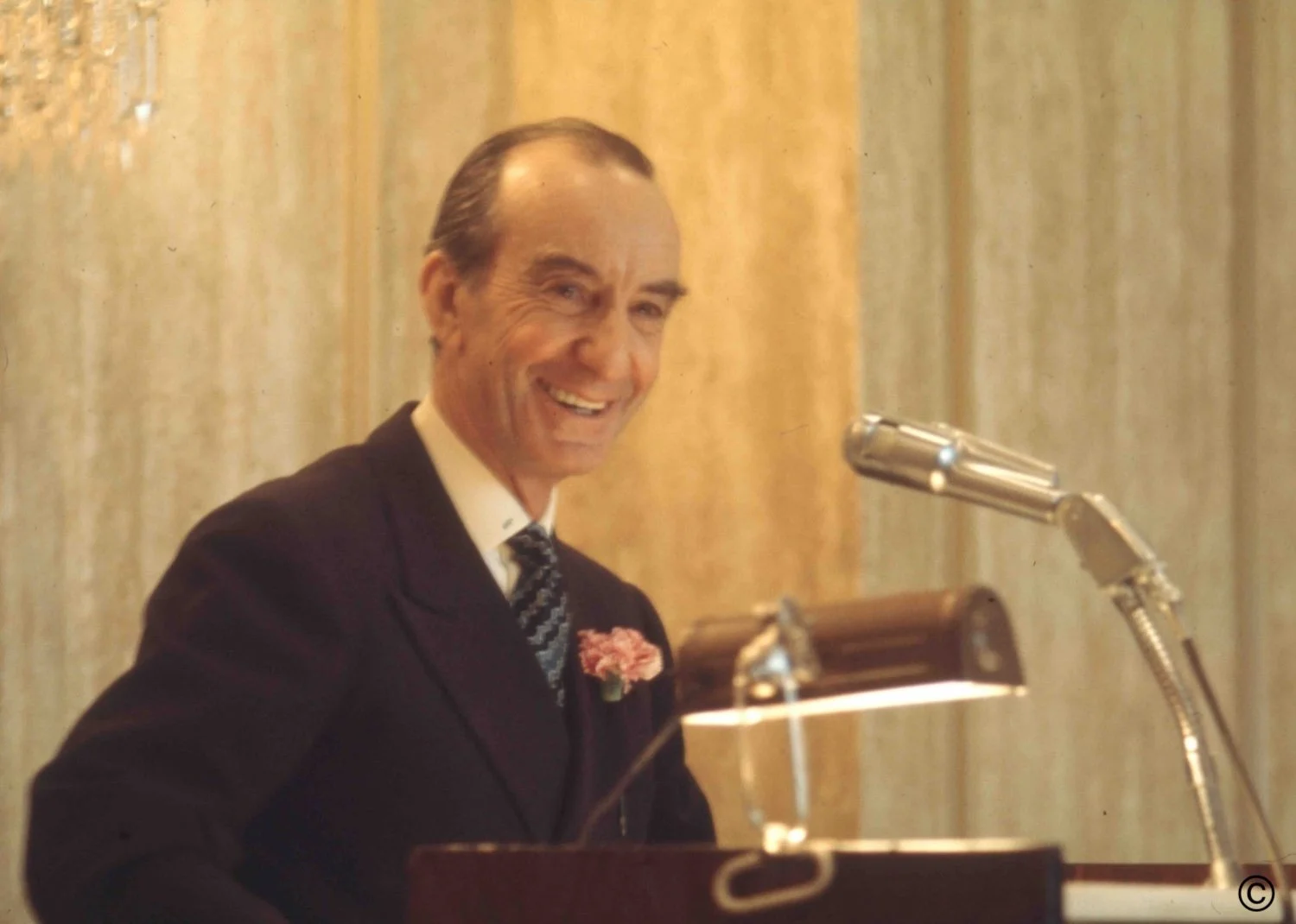
November 20, 1914
Emilio Pucci Marchese di Barsento, who designed the first full couture line of uniforms for Braniff’s employees from 1965 to 1975, is born on this day

October 17, 1917
Dallas Love Field Airport is founded on this date, which became Braniff’s headquarters in 1941 with full move from Oklahoma City completed in 1942. Braniff Engineering and Maintenance moved to Love Field in November 1934.
Photo: A unique Braniff International Airways advertisement placed in the Dallas Times Herald Newspaper dated October 20, 1957. A special section of the paper was reserved for the new Love Field Terminal along Cedar Spring Road that would open in early 1958. Copyright, Braniff Airways, Incorporated
June 27, 1918
Thurman Braniff, the only son of company co-founder Thomas Elmer Braniff and his wife Bess Braniff, is born on this day. Young Mr. Braniff was planning a career in aviation when his life was cut short in a student training flight accident at Oklahoma City in the summer of 1938
1920 to 1929
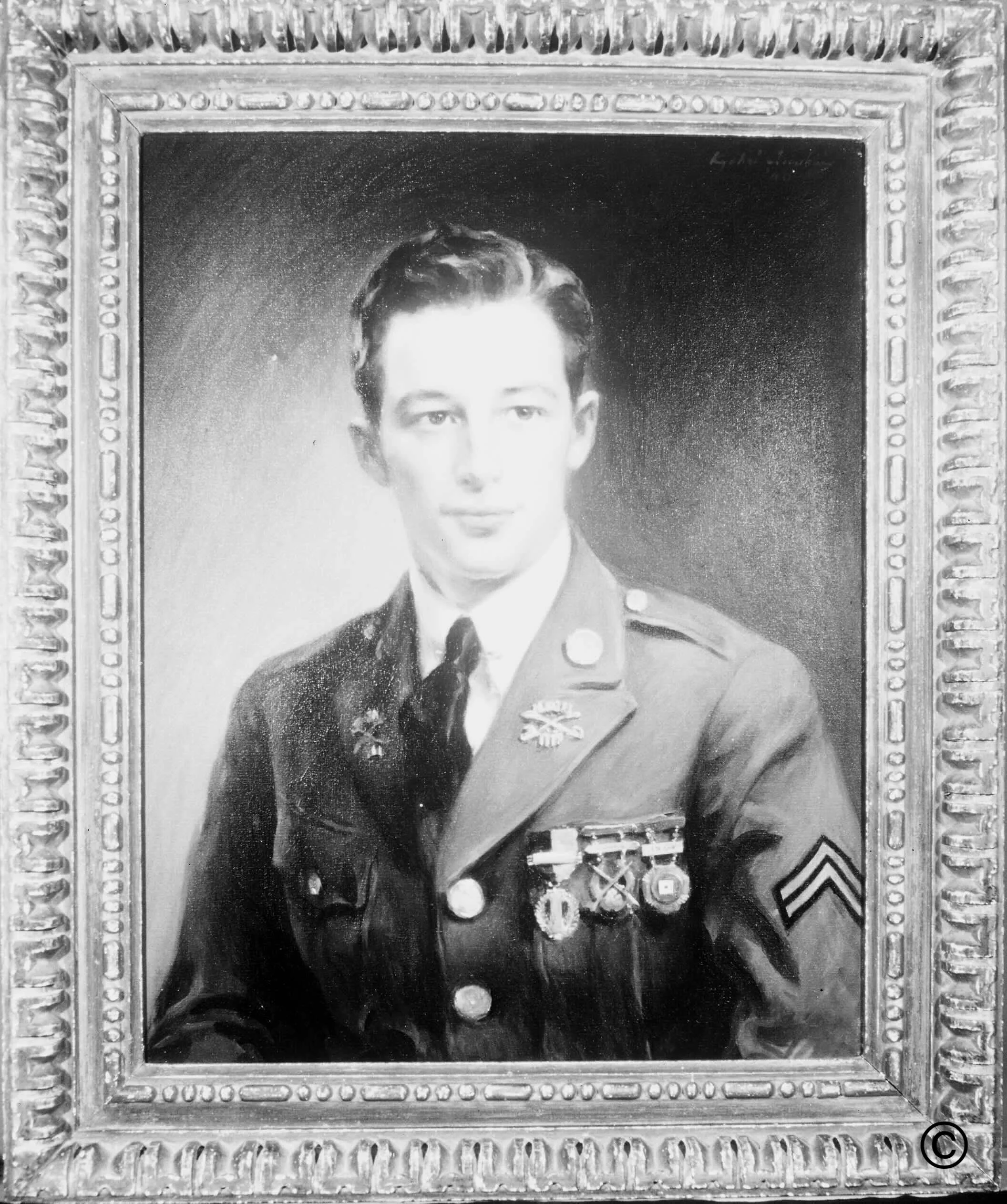
May 24, 1907
Alexander Hayden “Sandro” Girard is born on this date and gained airline industry accolades for his bright and colorful schemes that he created for Braniff’s jets in 1965 and was responsible for changing the way Braniff presented itself to the public

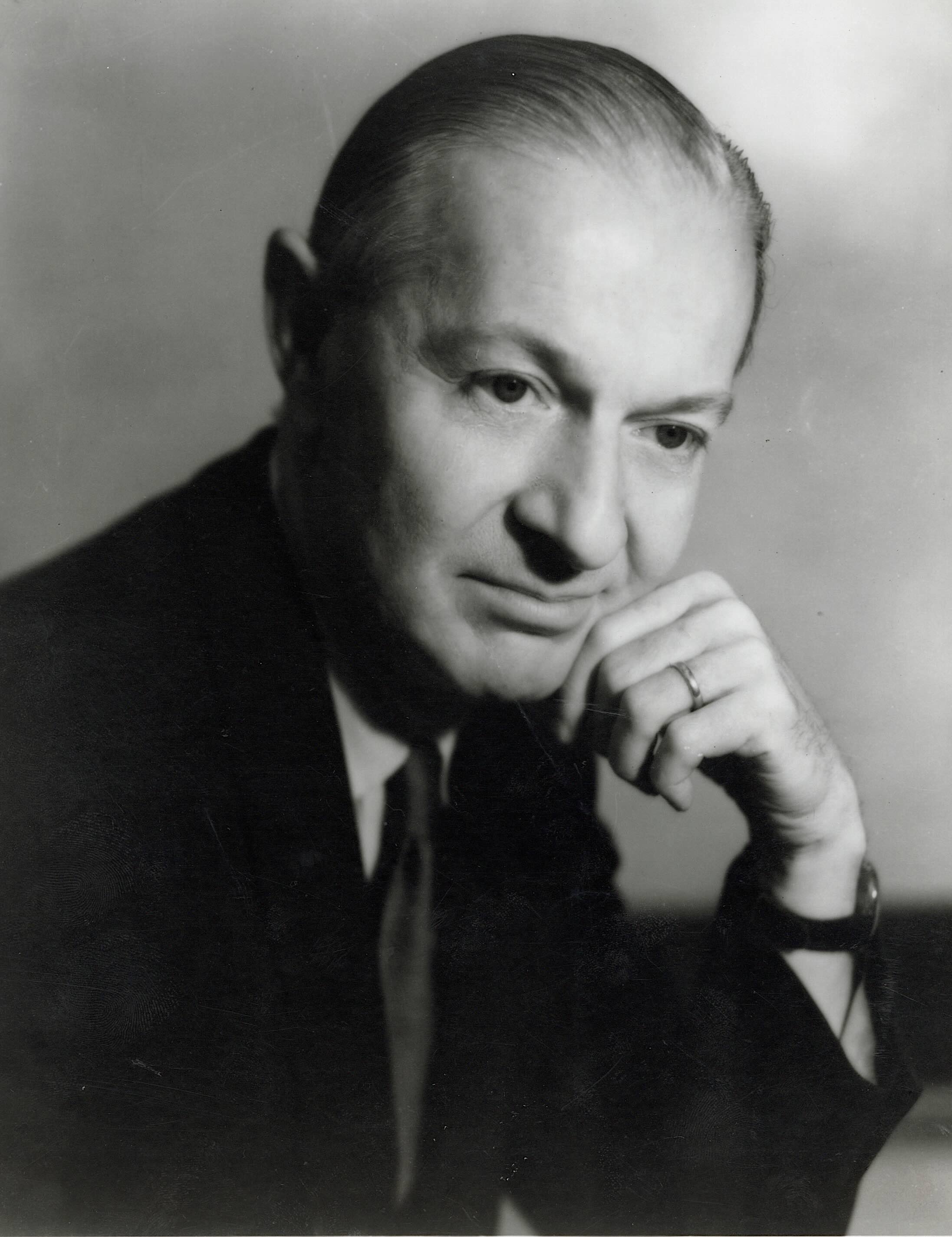
July 15, 1920
Harding Luther Lawrence is born on this day in Perkins, Oklahoma. He catapults Braniff into a global airline powerhouse after joining the company in 1965 as President replacing the retiring Charles Edmund Beard.
Photo: Mr. Lawrence displays a model of the Airline’s new Boeing 727-27C Quick Change Convertible Cargo/Passenger Trijet airliners in this 1966 photo. Copyright, Braniff Airways, Incorporated.
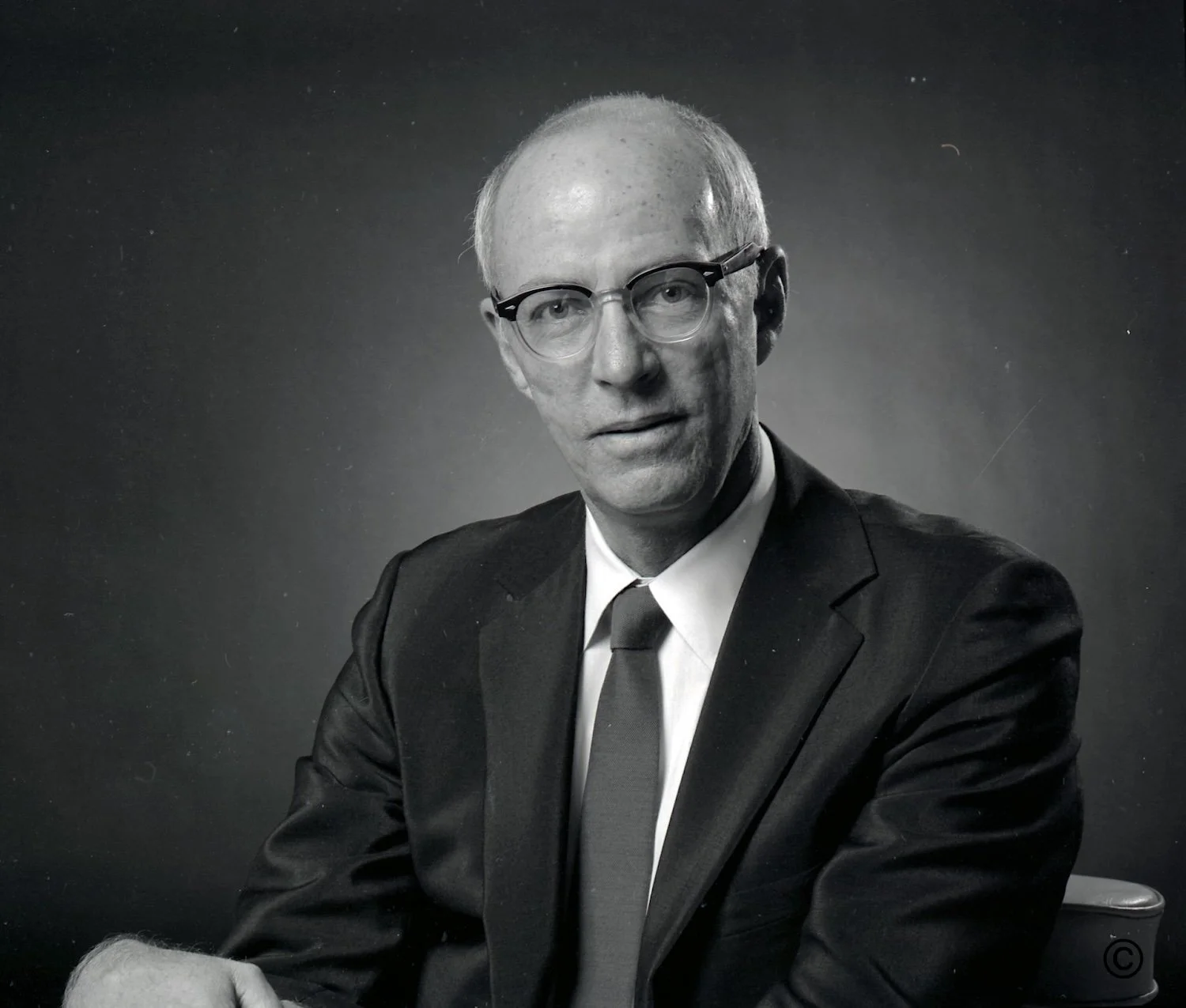
November 23, 1920
Captain Wilford Woodruff Garbett is born on this date, and guided Braniff’s Flight Operations Department during the 1970s
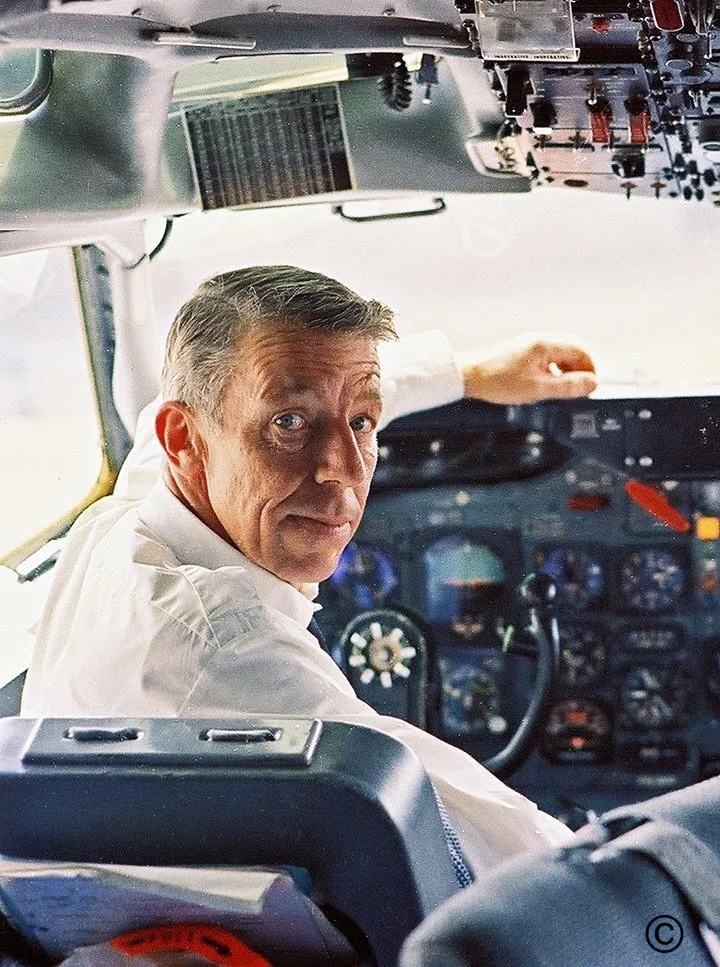
March 23, 1922
Captain Len Morgan birthday, the beloved Braniff pilot and well-known FLYING Magazine editor, is born on this date
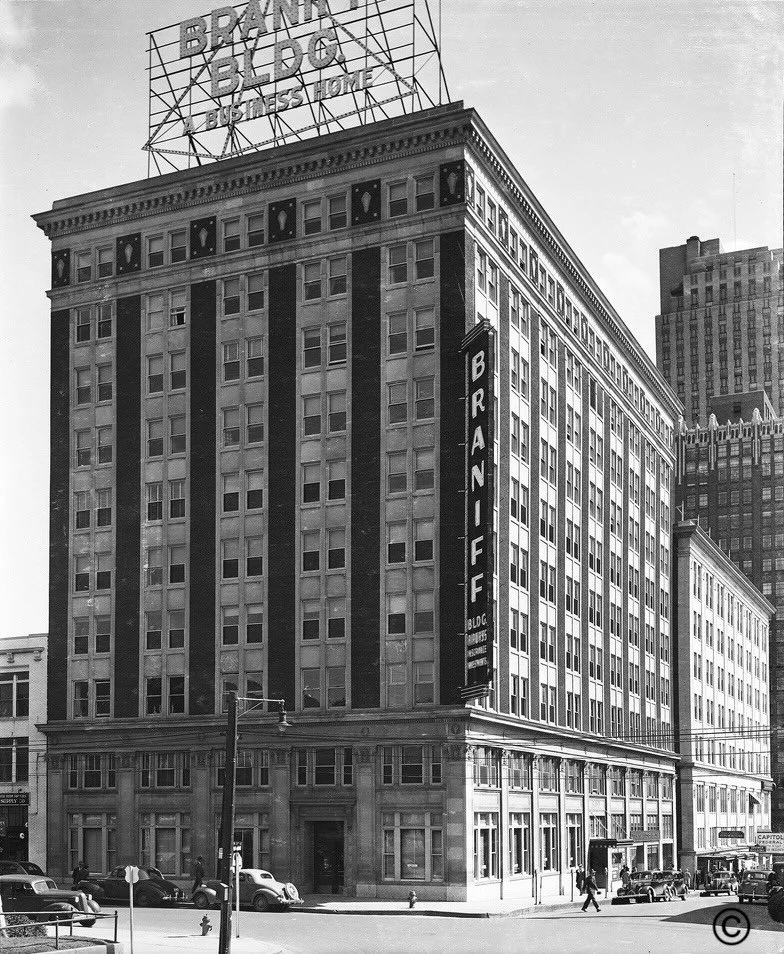
July 1, 1923
T. E. Braniff Insurance Company moves in to new Braniff Building on the second floor of the first skyscraper in Oklahoma City, which would house Braniff air carrier administration offices from 1928 to 1941

August 1, 1923
T. E. Braniff Insurance Company moves from the second floor to the ground floor in new Braniff Building in Oklahoma City and all tenants move in upon building completion on this date.
Photo: This photo was taken by the T. E. Braniff Company of its current staff at the old building in Oklahoma City, just before moving to the new building at 324 North Robinson Avenue. Copyright, Braniff Airways, Incorporated
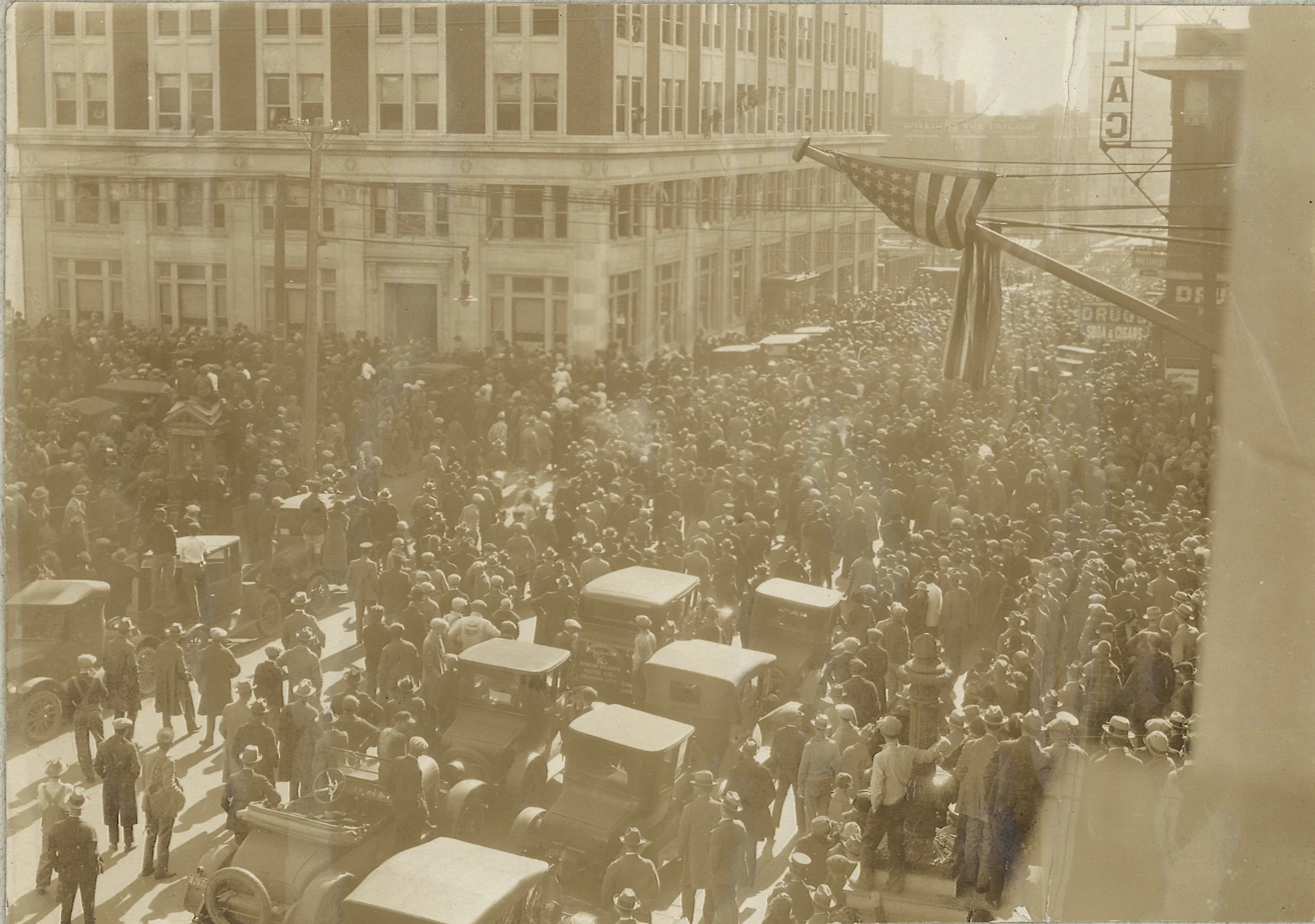
November 3, 1923
Ceremonies are held for the grand opening of the new Braniff Building in Oklahoma City. Thousands of well-wishers show up for the opening of the building in spite of the cold temperatures.

April 1, 1926
First Braniff aviation entity, Braniff Airlines, Inc., is formed most likely as a Flight School and Aircraft Dealer, which was located at the original Oklahoma City Municipal Airport, which was known as the SW 29th Street Field.
Photo: In this aerial photo, the former airport lands can be seen at the corner of SW 29th Street and May Avenue in the lower part of the photo. This area is now Woodson Park and in 1932, airline operations were moved to the new Will Rogers Airport, which was southwest of this site. Photo Oklahoma City Historical Society

November 19, 1926
George Stanley Gordon, the vaunted advertising agent who came up with the idea of an artist painting a full-size jet airliner, is born on this date. Mr. Gordon brought Alexander Calder and Braniff Airways together to paint two Braniff jetliners.
Photo: Master Artist Alexander Calder, left, is assisted by George Gordon with painting one of the eight Pacific Miniatures brand 1/25 Scale McDonnell Douglas DC-8-62 floor models in the new proposed Calder Braniff color schemes in early 1973. Copyright, Braniff Airways, Incorporated

October 3, 1927
Oklahoma Aero Club is founded in Oklahoma City by Paul R. Braniff, Thomas Elmer Braniff and other prominent Oklahoma City businessmen. The club was formed with a single-engine Stinson-Detroiter aircraft registered as NC1929 that Paul Braniff had purchased. The group wanted to use the aircraft for personal and business reasons while sharing costs. The Stinson-Detroiter became the first passenger aircraft of Paul R. Braniff, Inc., the first Braniff scheduled airline entity, which was formed in May 1928. The Aero Club fell victim to one airplane with to many owners wanting to go at the same time to different destinations
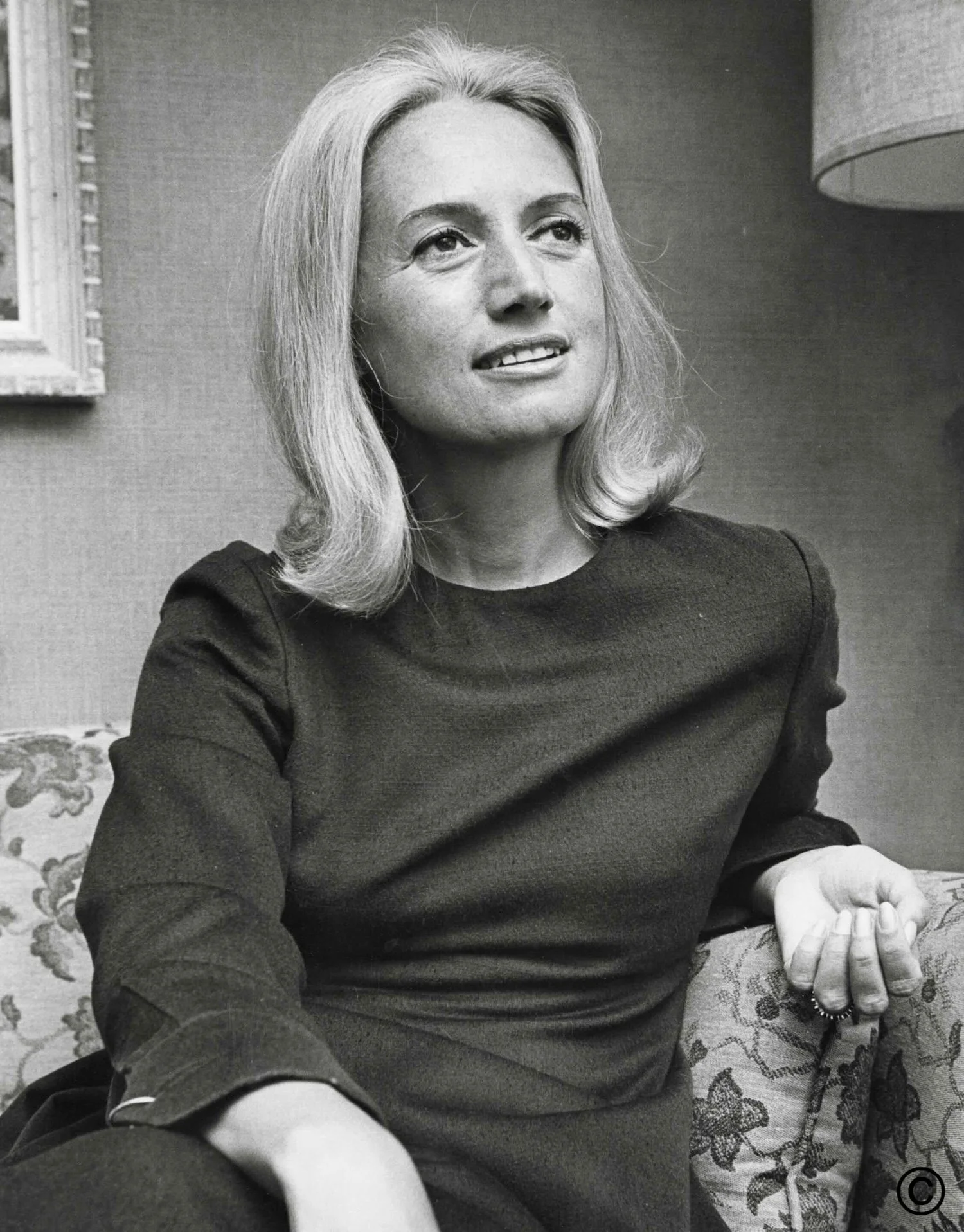
May 25, 1928
Mary Georgene Berg Wells Lawrence is born on this date. Ms. Wells was with Braniff’s ad agency Jack Tinker and Partners and was tasked with completely reinventing Braniff’s image in 1965. She created Braniff’s famed End of the Plain Plane Campaign and went on to become the first woman to own a Madison Avenue advertising agency, Wells, Rich, Green. She married Braniff Airways President Harding L. Lawrence in November 1967
PAUL R. BRANIFF IN 1928

May 29 1928
Brothers Thomas Elmer Braniff and Paul Revere Braniff establish their first scheduled airline, Paul R. Braniff, Inc, d/b/a Tulsa-Oklahoma City Airline, in Oklahoma City. The new company also sold new Travel Air aircraft, sold Curtiss and Whirlwind parts and offered flight training.
Photo: The first page of the original Articles of Incorporation of Paul R. Braniff, Inc., also known as the Tulsa-Oklahoma City Airline, from the State of Oklahoma, and dated May 29, 1928. Copyright, Braniff Airways, Incorporated

June 20, 1928
Braniff's Birthday first scheduled flight Oklahoma City to Tulsa of Paul R. Braniff, Inc., with one round trip daily over the 116-mile distance with one 5-passenger Stinson Detroiter airliner and three employees. The company’s full fleet in the summer of 1928 was the Stinson-Detroiter, a Ryan B-1 Monoplane, two Travel Air 2000s, one Travel Air 4000-D, and two Travel Air A-6000-As
By the end of 1928, the company employed 16 people, which included six pilots, and its fleet consisted of two Travel Airs, two Stinson-Detroiters and one Ryan and the company had carried 3000 passengers during its short time in operation and by February 1929, service had been inaugurated at Wichita Falls and Dallas.
Photo: Paul R. Braniff, Inc., Stinson Detroiter registered as NC 1629 is parked on the ramp at Oklahoma City SW 29th Street Field on or about June 20, 1928. This photo was the first corporate photo of the new company and the only official company photo of its first aircraft. Copyright, Braniff Airways, Incorporated
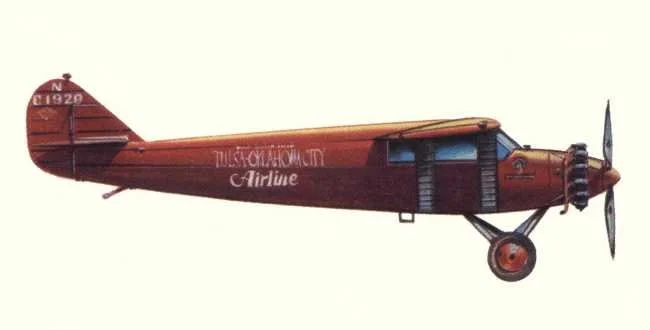
July 20, 1928
Paul R. Braniff, Inc., reports its first profit in the first month of operation. An artist’s rendering of the first Stinson Detroiter indicates the first color scheme was a solid dark red or maroon color. Kodak was asked to analyze Braniff’s black and white photo of the first Detroiter and the film company confirmed that the first company aircraft was painted in dark red or maroon
PAUL R. BRANIFF IN 1929

April 26, 1929
The Paul R. Braniff, Inc., timetable, effective this date, indicated that the company was operating three daily flights between Oklahoma City and Tulsa and two daily flights between Oklahoma City and Wichita Falls
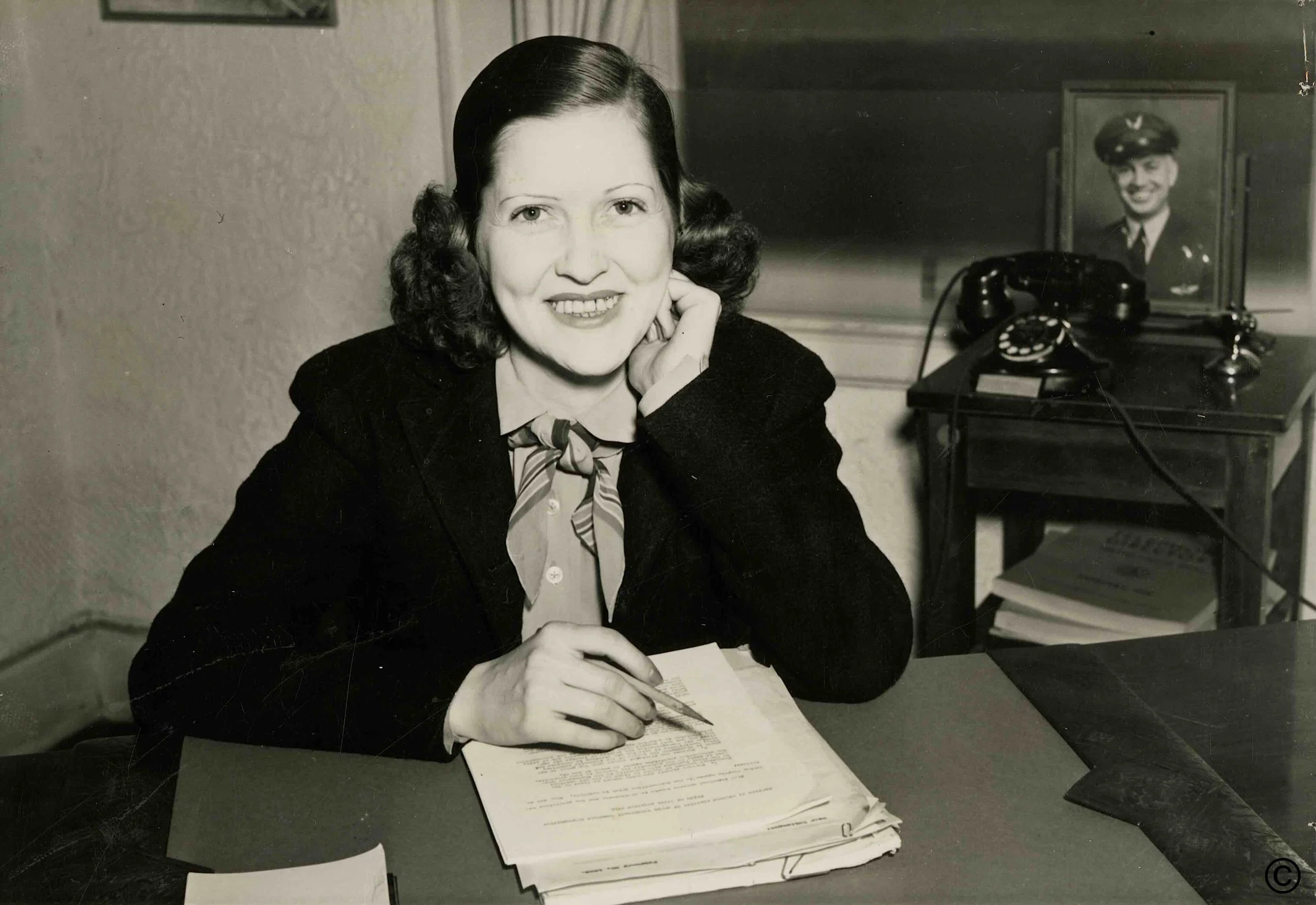
March 1, 1929
The company hired its first female employee, Ms. Violet “Bobbie” Burton, as Paul R. Braniff’s secretary but kept the company’s accounting, learned how to report weather reporting and service company aircraft including refueling and oil and managed the flight training program. In 1937, she conducted the company’s first hostess training class and later married Braniff pilot Virgil Turnbull.
Photo: Ms. Bobbie Burton Turnbull at her desk in the Hostess Department in Oklahoma City in 1937. She was appointed the Airline’s first Chief Hostess that same year. Copyright, Braniff Airways, Incorporated
April 15, 1929
Paul R. Braniff, Inc., is sold to Universal Aviation Corporation, which became American Airways in 1932 and American Airlines in 1934. Paul R. Braniff, Inc., became Braniff Air Lines, Inc., a division of Universal Aviation Corporation with Paul Braniff acting as Executive Vice President and Ms. Bobby Burton continued in her role as secretary and office manager and continued to direct the flight school operations

July 15, 1929
Braniff Air Lines, Inc., operated service from Oklahoma City to Wichita Falls to San Angelo; the company’s original route from Oklahoma City to Tulsa and then new service to Wewoka to Dallas and then Ft. Worth and finally Oklahoma City to Wewoka to Seminole to Tulsa.
Photo: Paul R. Braniff, Inc.’s, terminal, office and hangar at Oklahoma City’s SW 29th Street Field was taken over by Universal Airlines System with it purchase of Braniff in 1929. Copyright, Braniff Airways, Incorporated

September 1, 1929
Company inaugurates express and package air freight service throughout its system with packages delivered within 30 minutes after the aircraft landed.
Photo: A Universal Airways Braniff Airlines Division Fairchild 71 registered as NC 9154 was on display during an air show at Post Army Air Field, Ft. Sill, Oklahoma, in 1929. Photo: Braniff Airways, Incorporated

November 1, 1929
Braniff Air Lines, Inc., Executive Vice President Paul R. Braniff resigns from the company and departs for a new position with Corporacion Aeronautica de Transportes, S.A., known as the CAT Line, based in Coahuila, Mexico, as Director of Operations. CAT Line flew from El Paso to Torreon and Mazatlan, in Mexico, with Lockheed Vegas. The airline touted that it flew “The World’s Fastest Commercial Airplanes” which would be similar to the new Braniff Airways slogan, “World’s Fastest Airline. Braniff Airways, Incorporated, also operated Lockheed Vegas
1930 to 1939
BRANIFF AIR LINES IN 1930
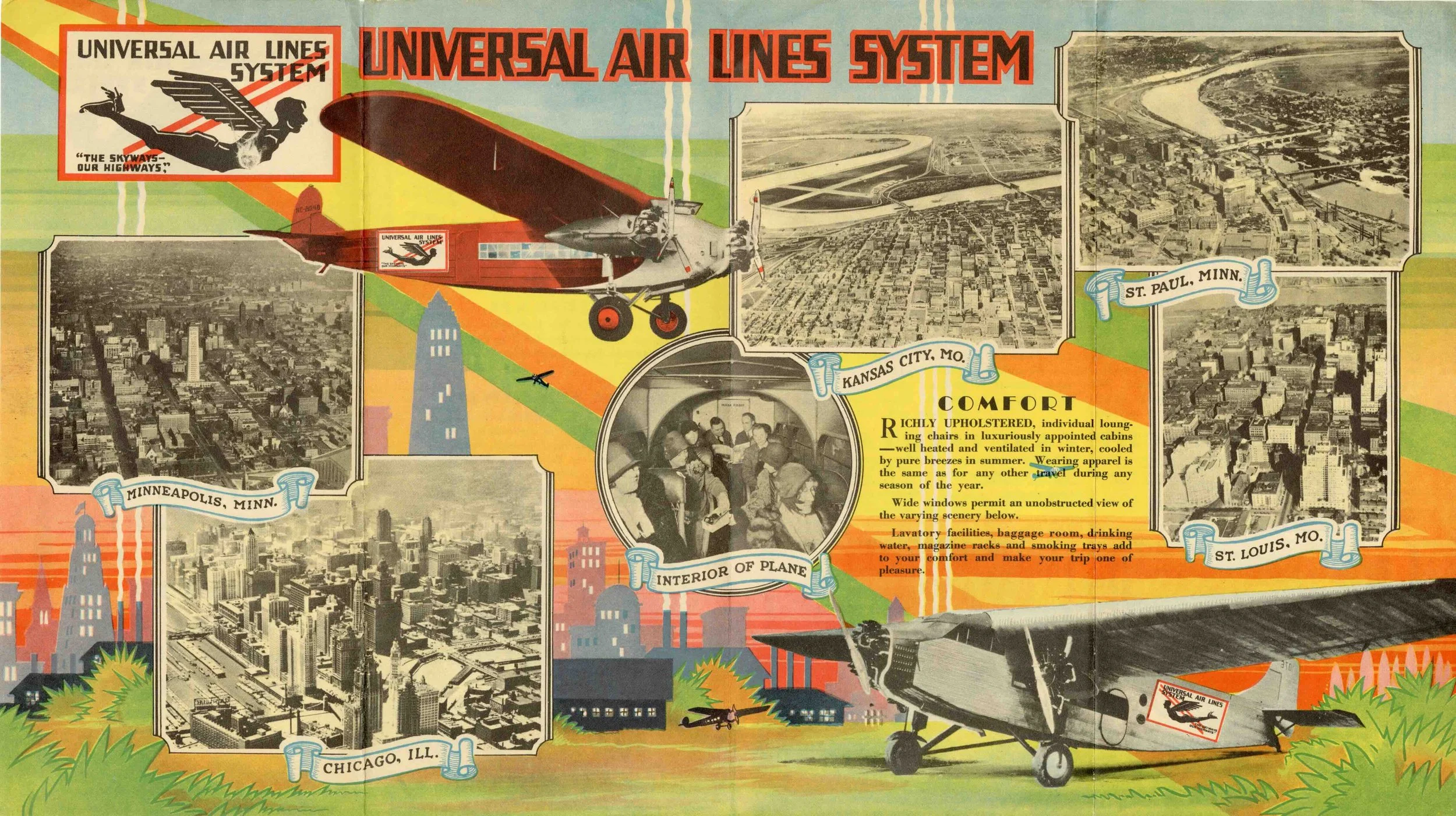
June 1, 1930
Universal Aviation Corporation, parent company of Braniff Air Lines, Inc., is sold to AVCO, which was incorporated in Delaware and based in New York City.
Photo: This unique center page of a Universal Airlines travel brochure denotes the various hub airports where the airline met up with railroad ground transportation
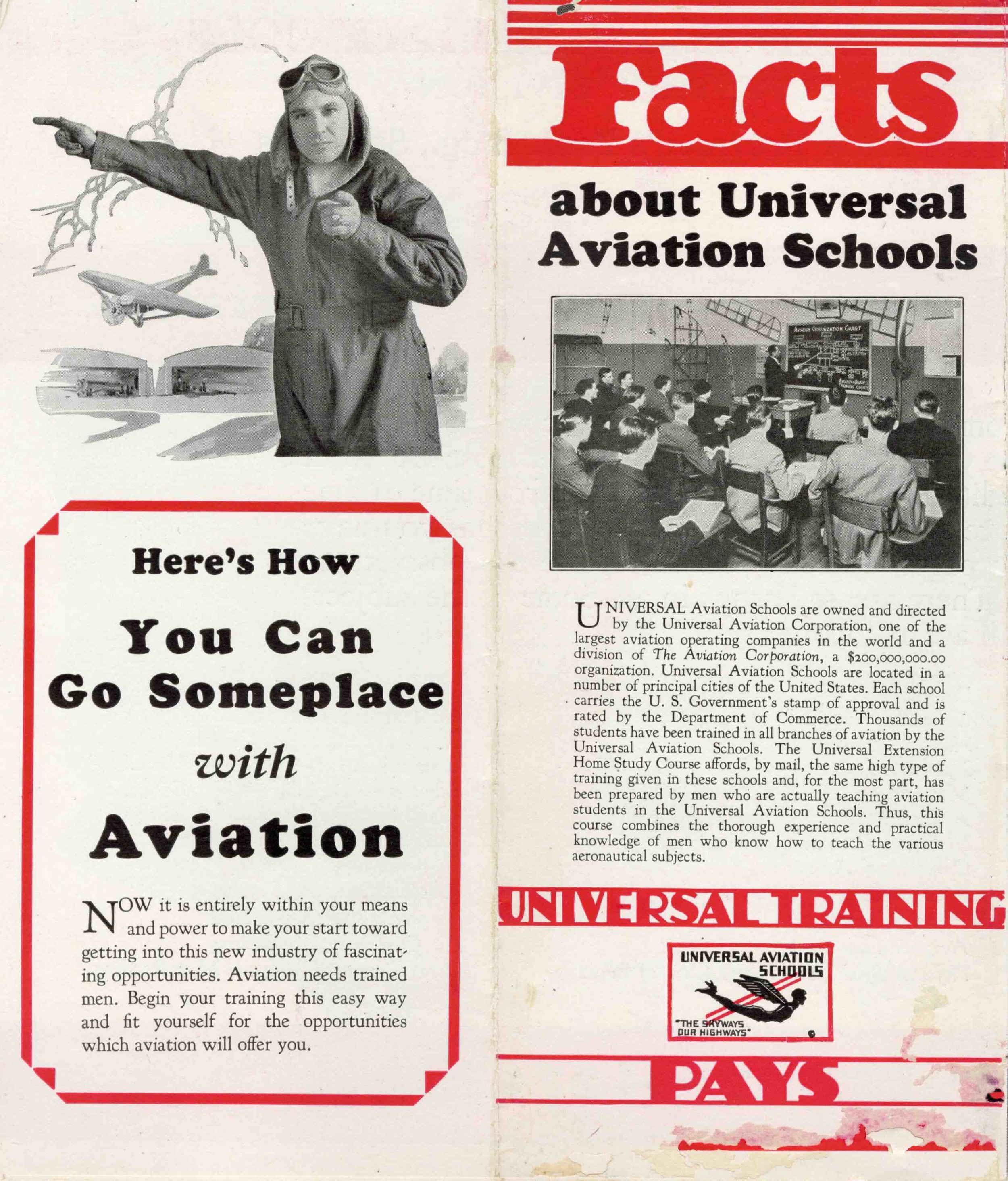
June 24, 1930
AVCO along with Braniff Air Lines, Inc., was merged into a new company, American Airways, which became American Airlines, Inc., in 1934.
Ad: Universal Airlines operated a series of aviation training schools including Braniff’s at Oklahoma City. The schools were well known for producing superb pilots and other aviation professionals.
BRANIFF AIRWAYS IN 1930

November 3, 1930
Braniff Airways, Inc., is formed in Oklahoma, with T. E. Braniff as President; E. E. Westervelt as Vice President and Paul R. Braniff as Secretary and Treasurer
November 13, 1930
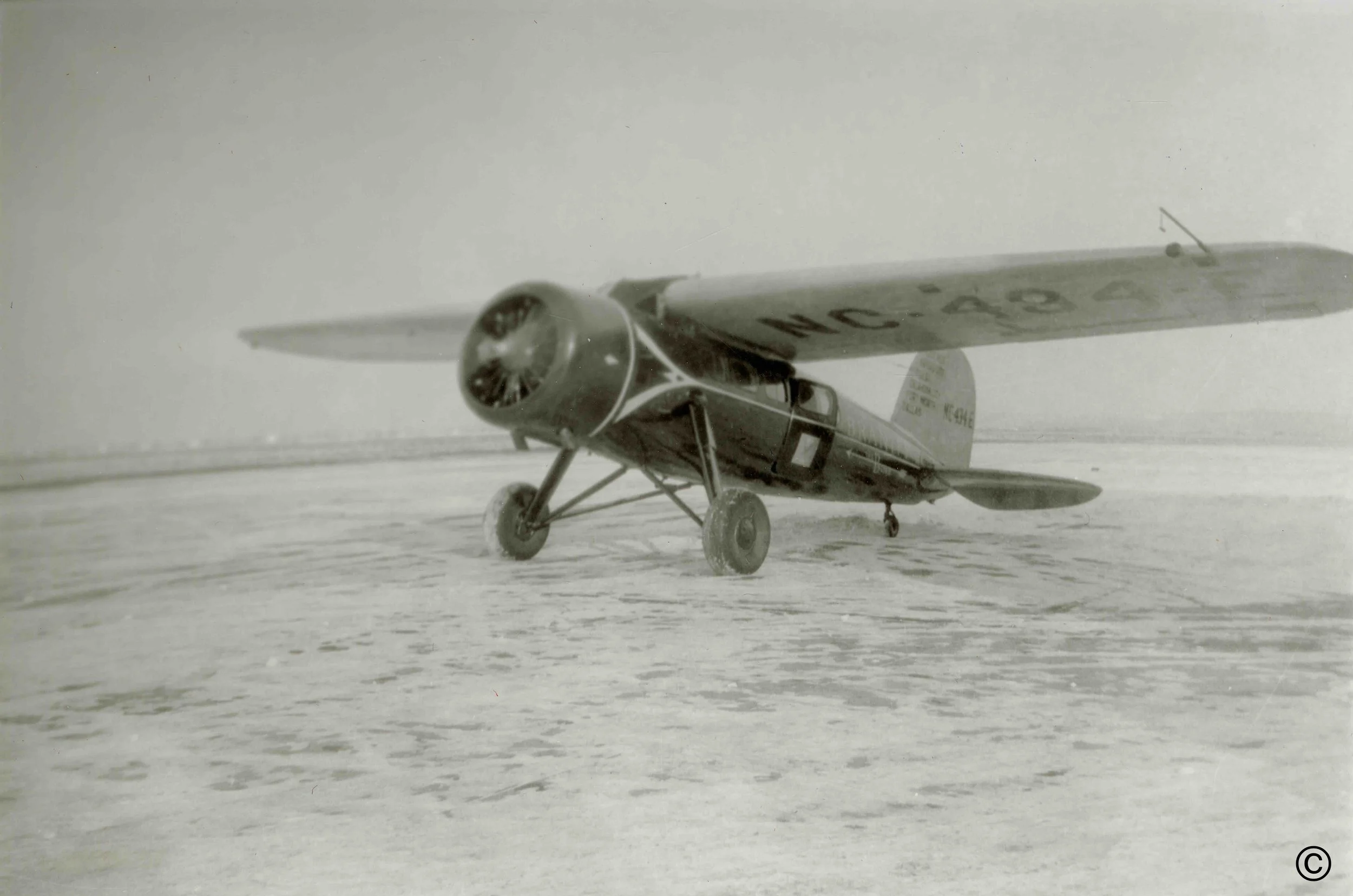
Braniff Airways, Incorporated, begins scheduled service between Tulsa, Oklahoma City, Oklahoma, and Wichita Falls, Texas, with two 6-passenger Lockheed Vega airliners.
Photo: Braniff Airways Lockheed Vega registered as NC 434E is taxiing in the snow at the SW 20th Street Field at Oklahoma City, in early 1931. Ship NC 434E was one of the first two aircraft Braniff began service. The company purchased three aircraft in November 1930, including NC 434E along with NC 433E and NC 195C, which were delivered into early 1931. Copyright, Braniff Airways, Incorporated
December 5, 1930
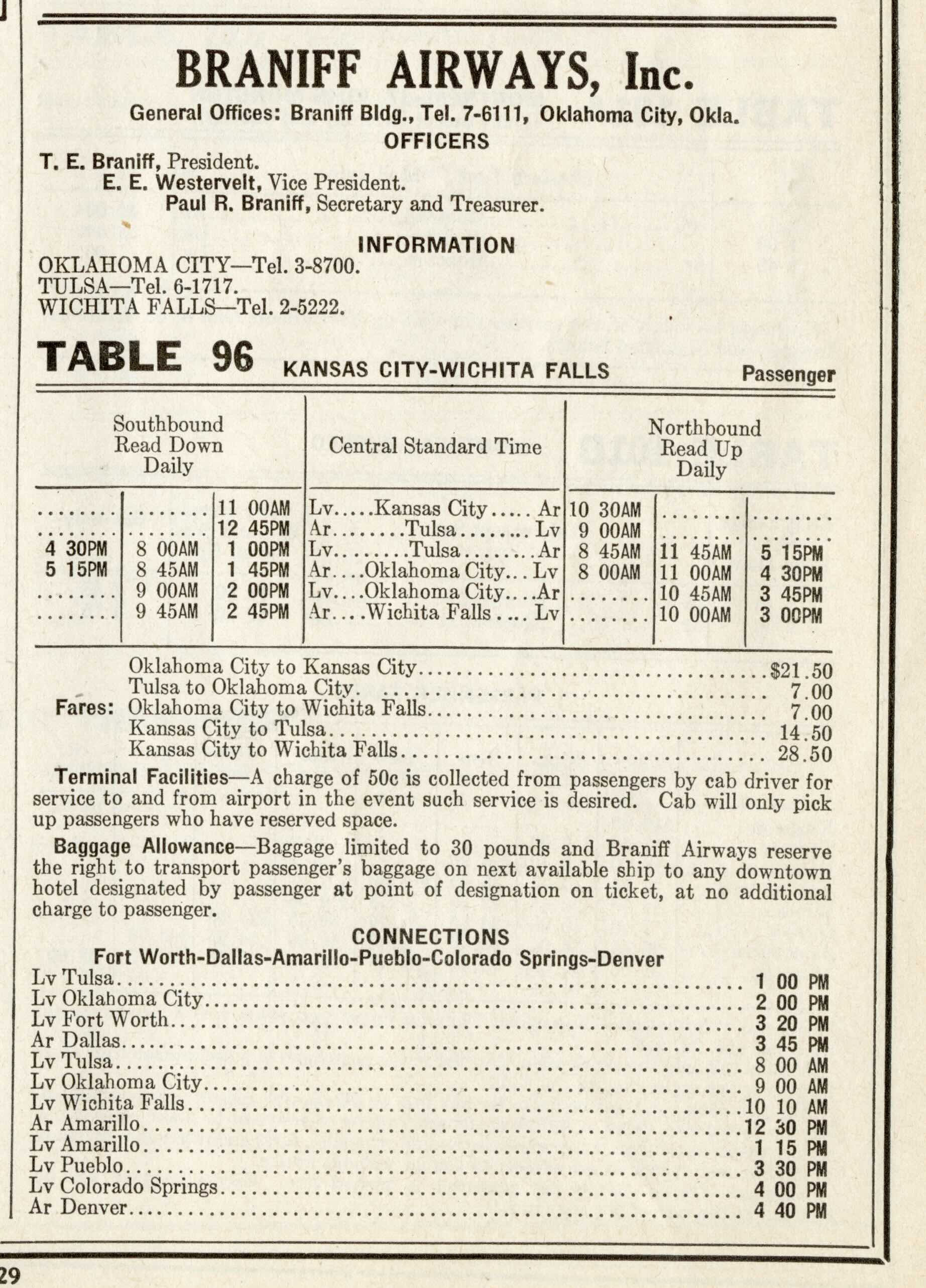
Service extended from Tulsa nonstop to Kansas City. Braniff’s first timetable issuance was in the Official Airline Guide or OAG for the January 1931, issue.
BRANIFF AIRWAYS IN 1931
February 25, 1931
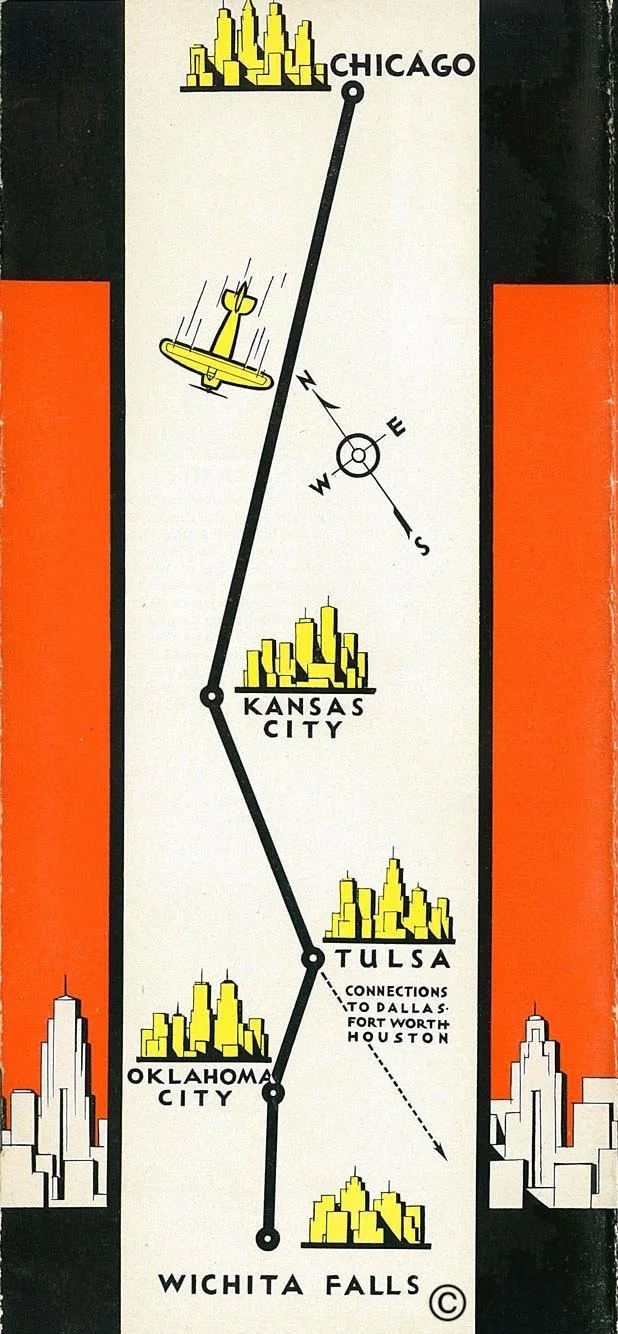
Single-plane service extended to Chicago from Kansas City with intermediate stops at Tulsa, Oklahoma City and Wichita

June 6, 1931
Mr. R. V. Carleton is hired as a pilot, whose 39-year career with Braniff would see him Chair the first Supersonic Transport Symposium in 1961 and later rise to Executive Vice President and Assistant to the Chairman of the Board.
Photo: Captain R. V. Carleton gives the ok sign as he is preparing to depart Boeing’s Renton, Washington, plant, near Seattle. He is picking up the new Boeing 707-227 El Dorado Jet registered as N7072 to fly to the Dallas Love Field Base in December 1959. Copyright, Braniff Airways, Incorporated
June 15, 1931
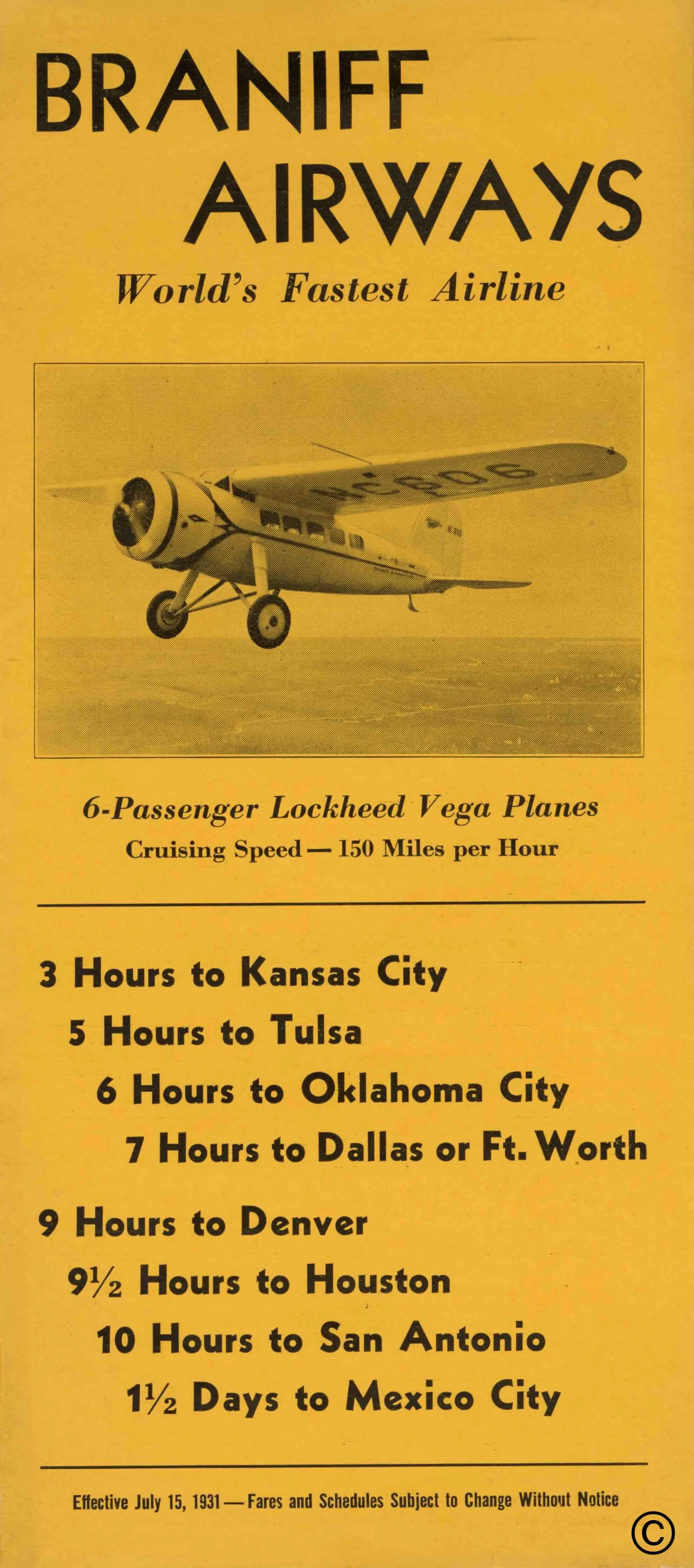
St. Louis added to Braniff route map with service to Chicago Midway Airport with intermediate stops at Oklahoma City and Kansas City. Braniff’s new St. Louis service schedules are posted in the July 15, 1931, timetable but strangely were not mentioned on the front page of the schedule, as shown here. Copyright, Braniff Airways, Incorporated
BRANIFF AIRWAYS IN 1932

June 27, 1932
Captain R. V. Carleton flies a speed record from Oklahoma City to Tulsa, aboard a Braniff Lockheed Vega single-engine 6-passenger airliner.
Photo: Captain R. V. Carleton stands with his Lockheed Vega airliner after he completed the record speed flight. Company President Paul Revere Braniff took this photograph. Copyright, Braniff Airways, Incorporated

April 23, 1932
Roy Halston Frowick is born on this date and in 1976 became the second Haute Couturier to design unforms for Braniff employees.
Photo: Halston in his mid-20s. Copyright, Rizzoli Books

May 27, 1932
Famed aviator Wiley Post flew on Braniff Airways as a passenger from Oklahoma City to Chicago, with Captain R. V. Carleton at the controls. Mr. Post’s Lockheed Vega, dubbed “Winnie Mae” was maintained by Braniff Airways at the Curtiss-Wright Airport Base in Oklahoma City

June 1, 1932
Additional Lockheed Vega added to the fleet bringing the total to six and company officials declare summer traffic as “good”.
Photo: Braniff Airways Lockheed Vega registered as NC 7953 is parked on the ramp at Oklahoma City Will Rogers Airport, on May 19, 1937. All Braniff service moved from the SW 29th Street Field to the new Oklahoma City Municipal Airport in 1932. Copyright, Braniff Airways, Incorporated
September 1, 1932
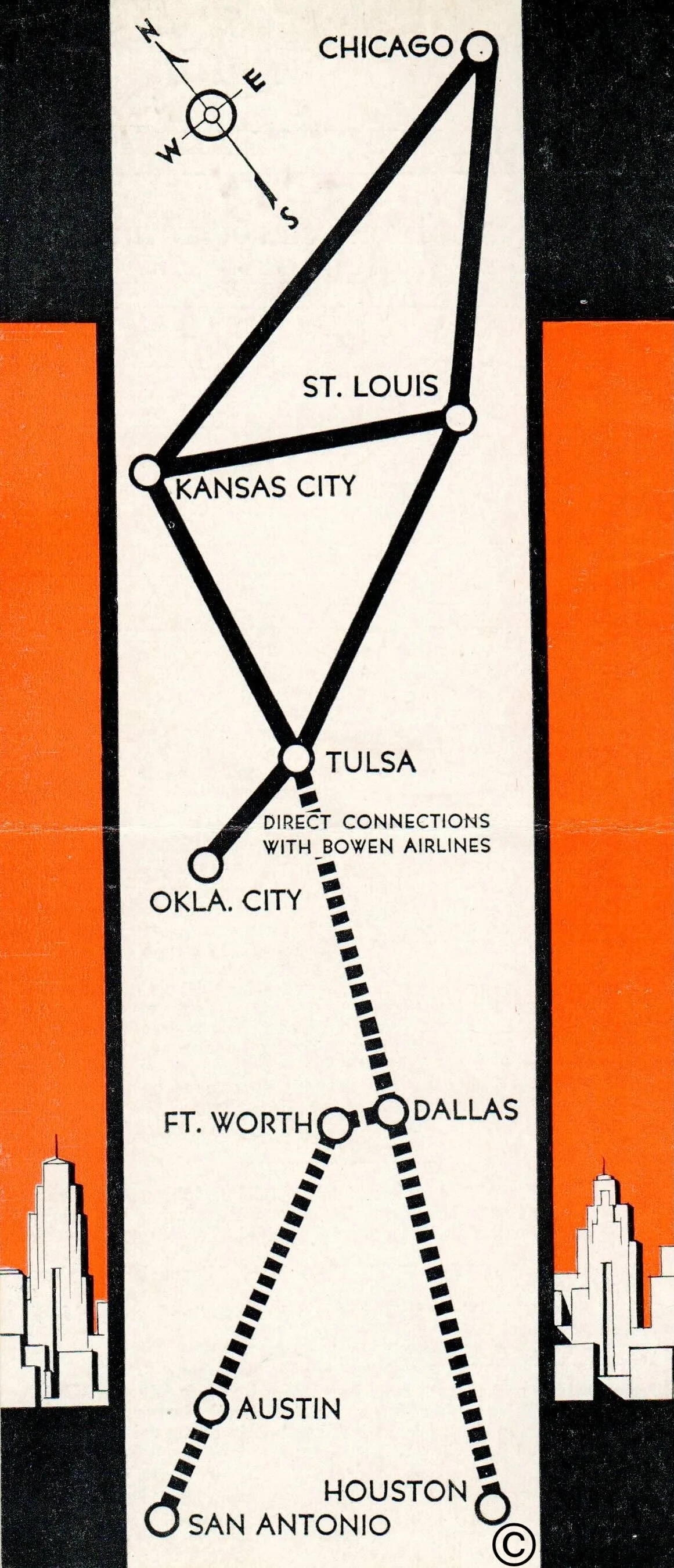
Service begins at Bartlesville, Oklahoma; Chanute and Coffeyville, Kansas and Springfield, Missouri.
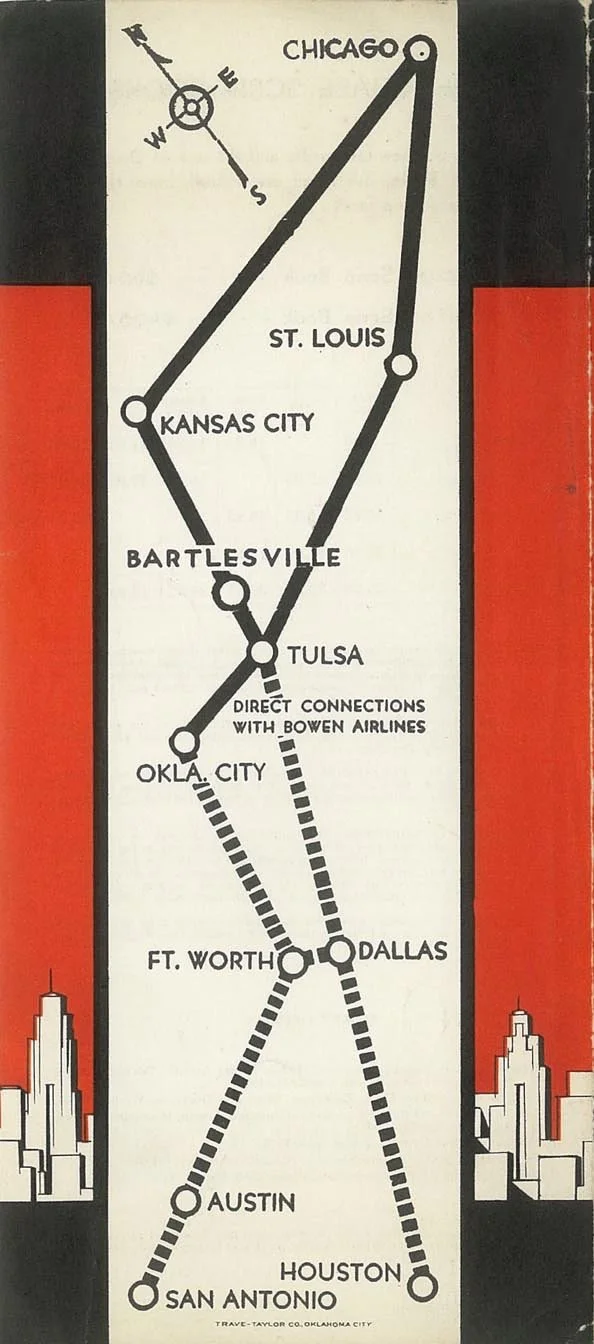
Photo: Braniff’s June 1, 1932, timetable route map shows that extension service was now available to Dallas, Ft. Worth, Austin, San Antonio and Houston, via connections at Tulsa to Bowen Airlines. Copyright, Braniff Airways, Incorporated
September 16, 1932
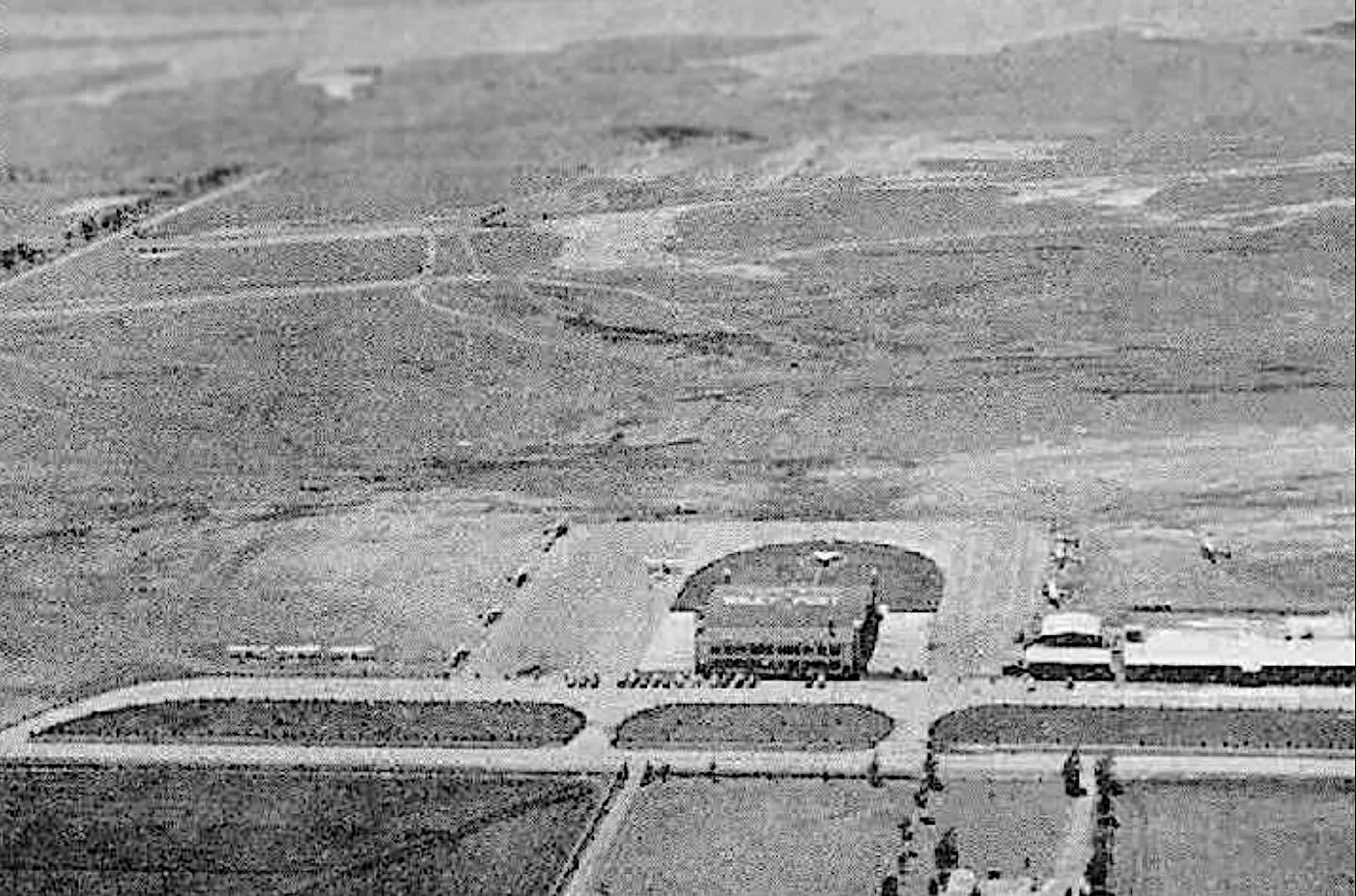
The company’s maintenance facility at Kansas City Municipal Airport is moved to Curtiss-Wright Airport in Oklahoma City and administrative offices are moved from the Braniff Building in downtown Oklahoma City to Curtiss-Wright Airport. Braniff was housed in the main hangar
December 31, 1932
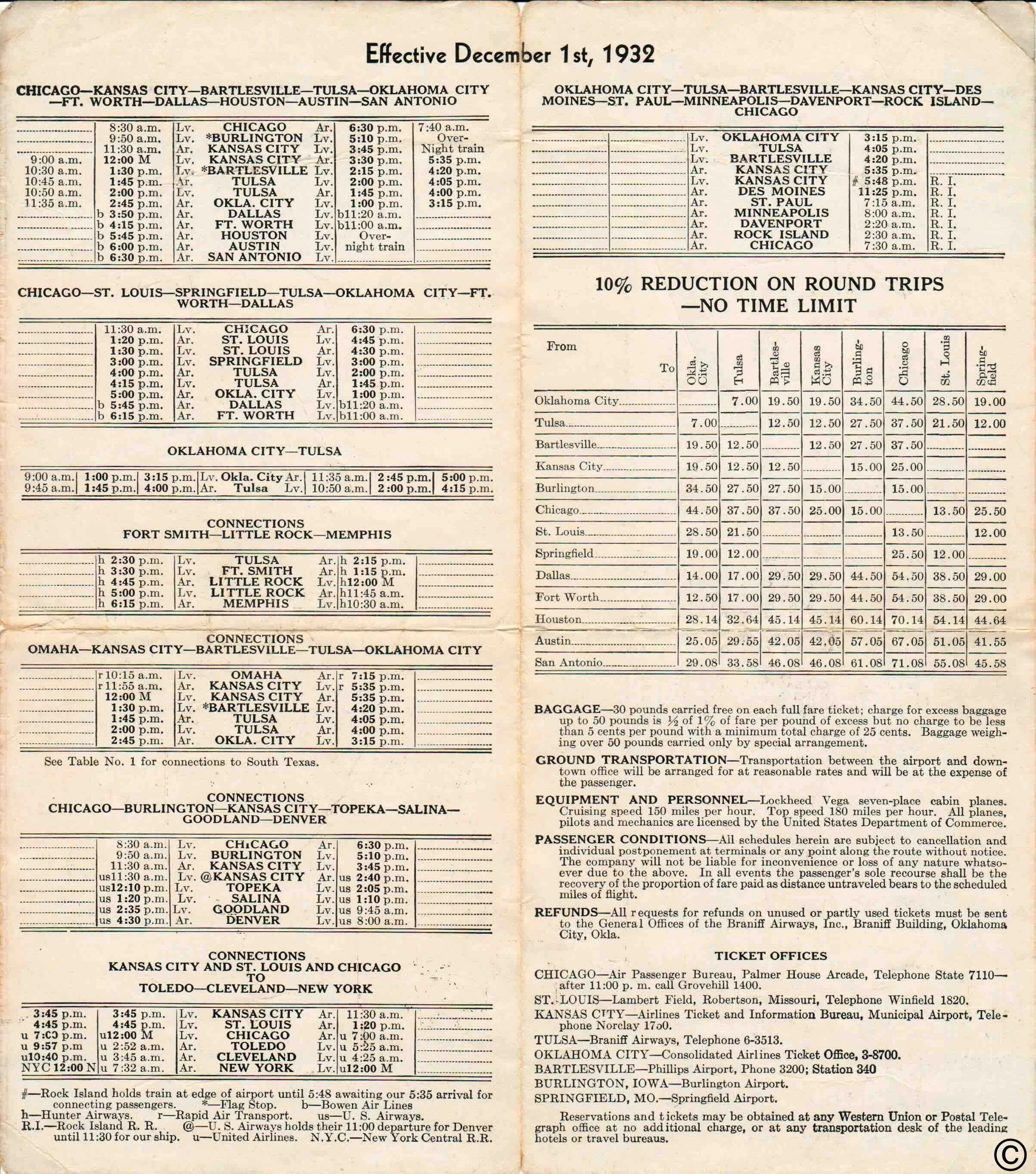
By this date, Braniff Airways was flying over 1420 miles of route system, flying only passengers and express cargo service.
Photo: Braniff Airways December 1, 1932, Timetable depicts the extensive schedules that the airline built in less than two year. Copyright, Braniff Airways, Incorporated
BRANIFF AIRWAYS IN 1933

May 15 and 29, 1933
Mr. Will Rogers flies on a Braniff flight from Kansas City to Tulsa, on May 15 and then on May 29, 1933, between Oklahoma City and Tulsa.
Photo: Mr. Post’s pilot was Captain R. V. Carleton, who pilot the big Lockheed Vega from Oklahoma City Municipal Airport to Tulsa Municipal Airport on May 29, 1933. Copyright, Braniff Airways, Incorporated
October 15, 1933
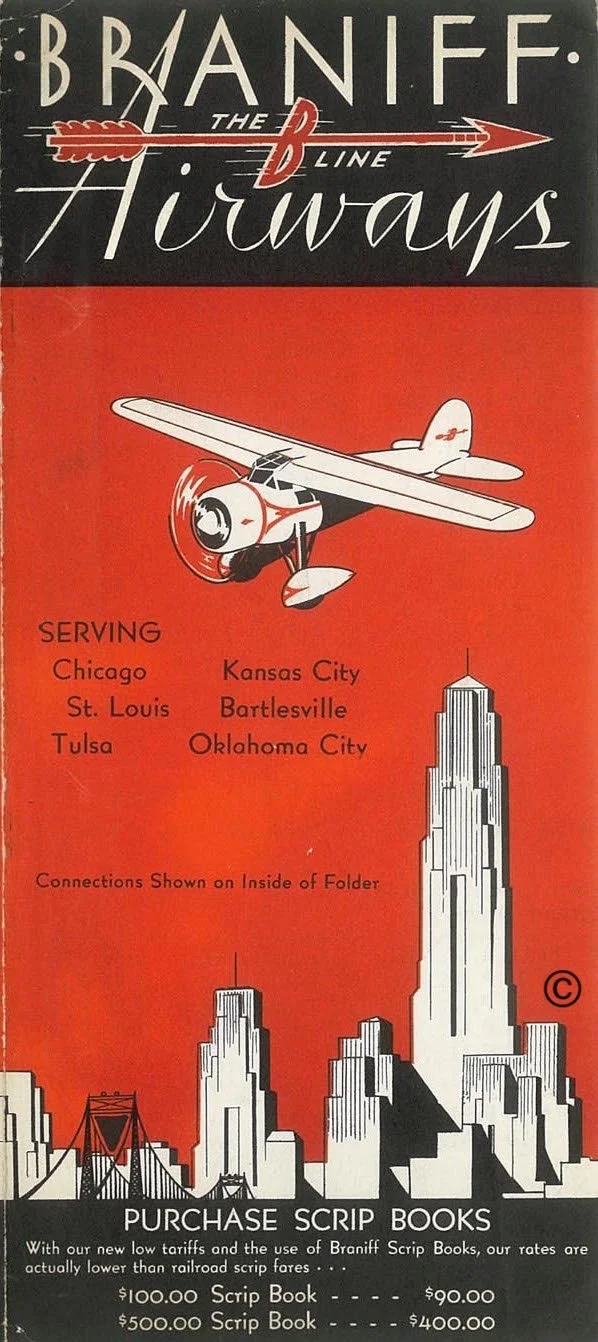
Braniff Airways reliance on passengers and express cargo without a US Mail contract caused the company to begin losing money. A meeting was held with the company’s 33 employees with Tom and Paul Braniff and the employees were told that they would need to work for “a living wage” from November 1, 1933 to October 1934, if the company was to survive.
Photo: Braniff Airways October 15, 1933 Timetable front cover. The bright cover was hiding the darkness of Braniff’s reliance only on passenger revenues. A US Mail contract was desperately needed and would arrive just in time. Copyright, Braniff Airways, Incorporated

December 10, 1933
Aviatrix legend Amelia Earhart flies from Tulsa to Kansas City on Braniff but the company’s financial condition is worsening as the nation reels from the Great Depression.
Photo: There are no known photos in Braniff’s Public Relations Department Archives of Ms. Earhart’s flight with us. However, Braniff honored Earhart’s impressive contributions to aviation and in honor of her flight with Braniff, third years earlier, this commemorative flight cover and stamp in conjunction with the US Postal Service. Copyright, Braniff Airways, Incorporated
BRANIFF AIRWAYS IN 1934
March 16, 1934
In spite of the valiant efforts of Braniff’s employees, the company ceased operations.
Photo: Braniff’s route map from late 1933. No new service was added during this time because of the economic conditions the company and its employees were enduring. Copyright, Braniff Airways, Incorporated

March 18, 1934
Braniff Airways made its last flight and its aircraft were locked in the hangar at Oklahoma City with only fixed base operations continuing in service. However, Congressional investigation of the nation’s air mail contracts caused them all to be canceled on February 19, 1934. Paul Braniff testified before Congress, which ultimately led to Braniff being awarded a key air mail contract less than two months later that saved the company

May 7, 1934
Braniff is awarded Air Mail Route AM-9 between Chicago and Dallas, with intermediate stops at Kansas City, Wichita, Ponca City, Oklahoma City and Ft. Worth.
Photo: Exactly 4 years later on the anniversary of Braniff’s lifesaving Air Mail Route Award, the Oklahoma City-based airline was now flying big 14-passenger Douglas DC-2 twin engine airliners with flight attendant service. Copyright, Braniff Airways, Incorporated

May 17, 1934
Air Mail service begins over Air Mail Route AM-9 and Braniff employees 47 people

May 30, 1934
Passenger and Express Cargo Services inaugurated northbound over AM-9

May 31, 1934
Passenger and express cargo services inaugurated southbound over US Air Mail Route AM-9.
Photo: Braniff Airways was on display at the World of Progress Show in Chicago, Illinois. The company was part of a demonstration of a new air mail delivery and retrieval system that would not require the aircraft to land at each mail stop. Instead, the new system allowed the pilot to fly low over the airport, deposit the mail and then pick up the new mail. Copyright, Braniff Airways, Incorporated

June 15, 1934
Inauguration of mail service only at Wichita, Kansas.
Photo: Braniff demonstrates the new wired delivery and retrieval system for air mail at the Chicago World of Progress event in May 1934.

August 1, 1934
Inauguration of flagship stop at Coffeyville, Kansas.
Photo: A postmarked letter flown aboard the first flight of Braniff’s new Air Mail Route 9 on May 17, 1934.
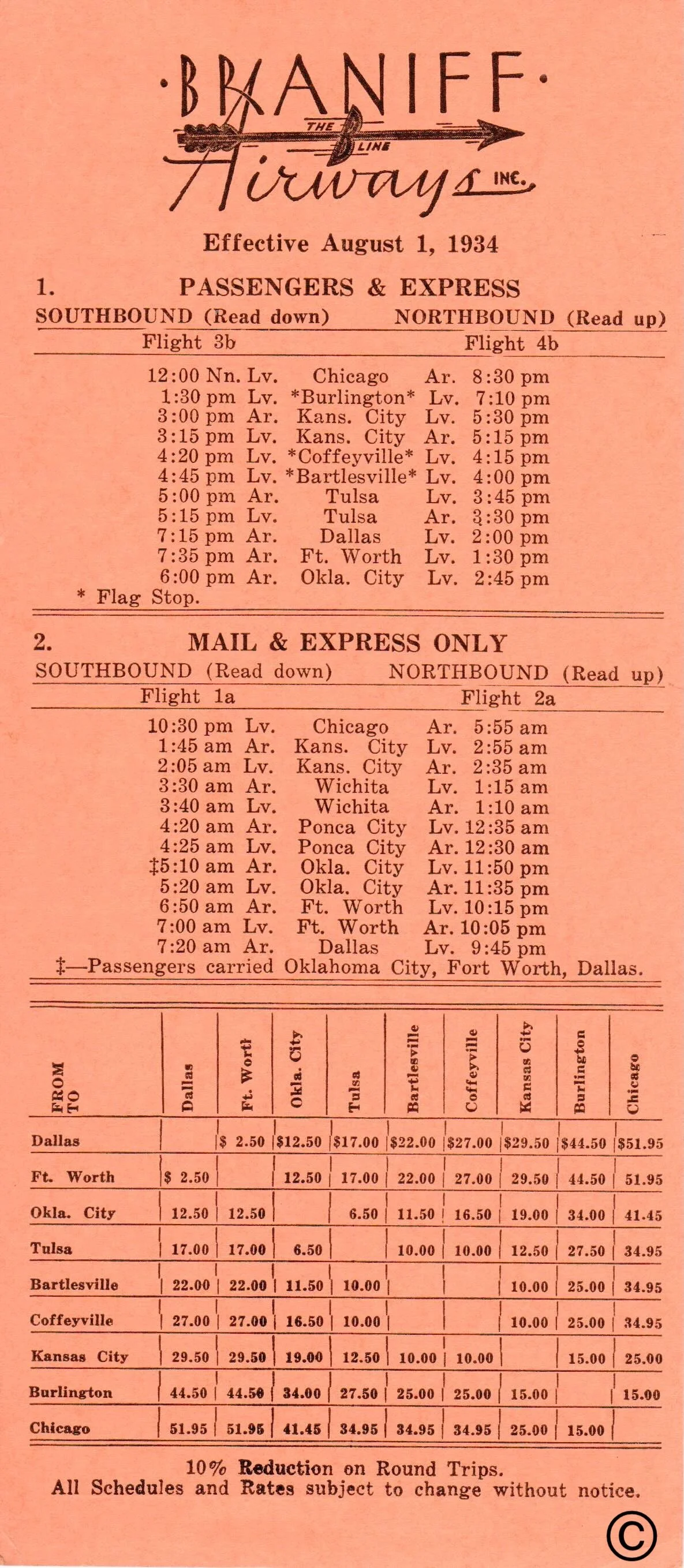
August 1, 1934
Braniff Airways Domestic Timetable dated August 1, 1934, denotes the extensive new service added since the award of Air Mail Contract 9 in May 1934.
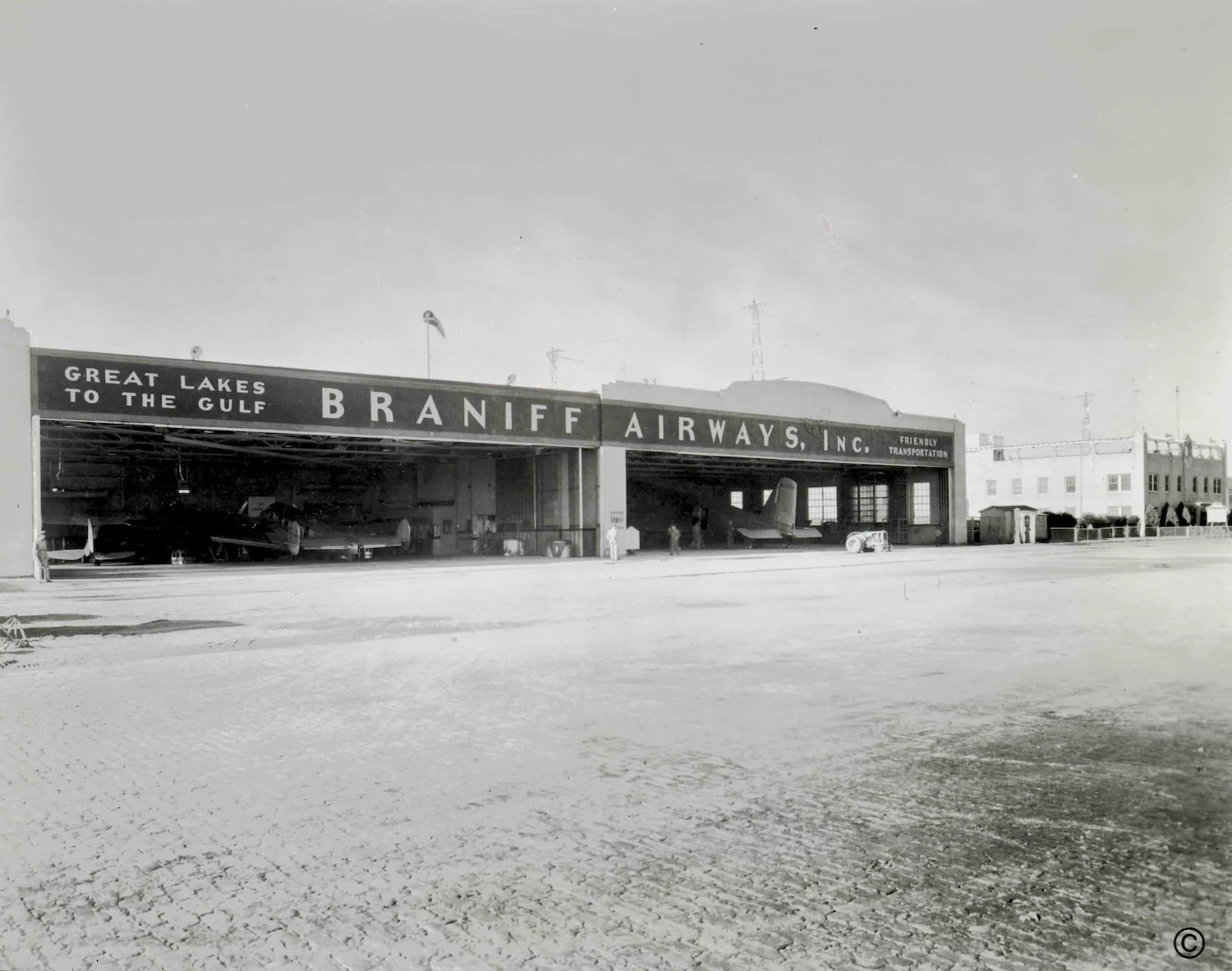
November 27, 1934
Operations and Maintenance Base moved from Oklahoma City to the north side of Dallas Love Field on Love Field Drive
December 28, 1934
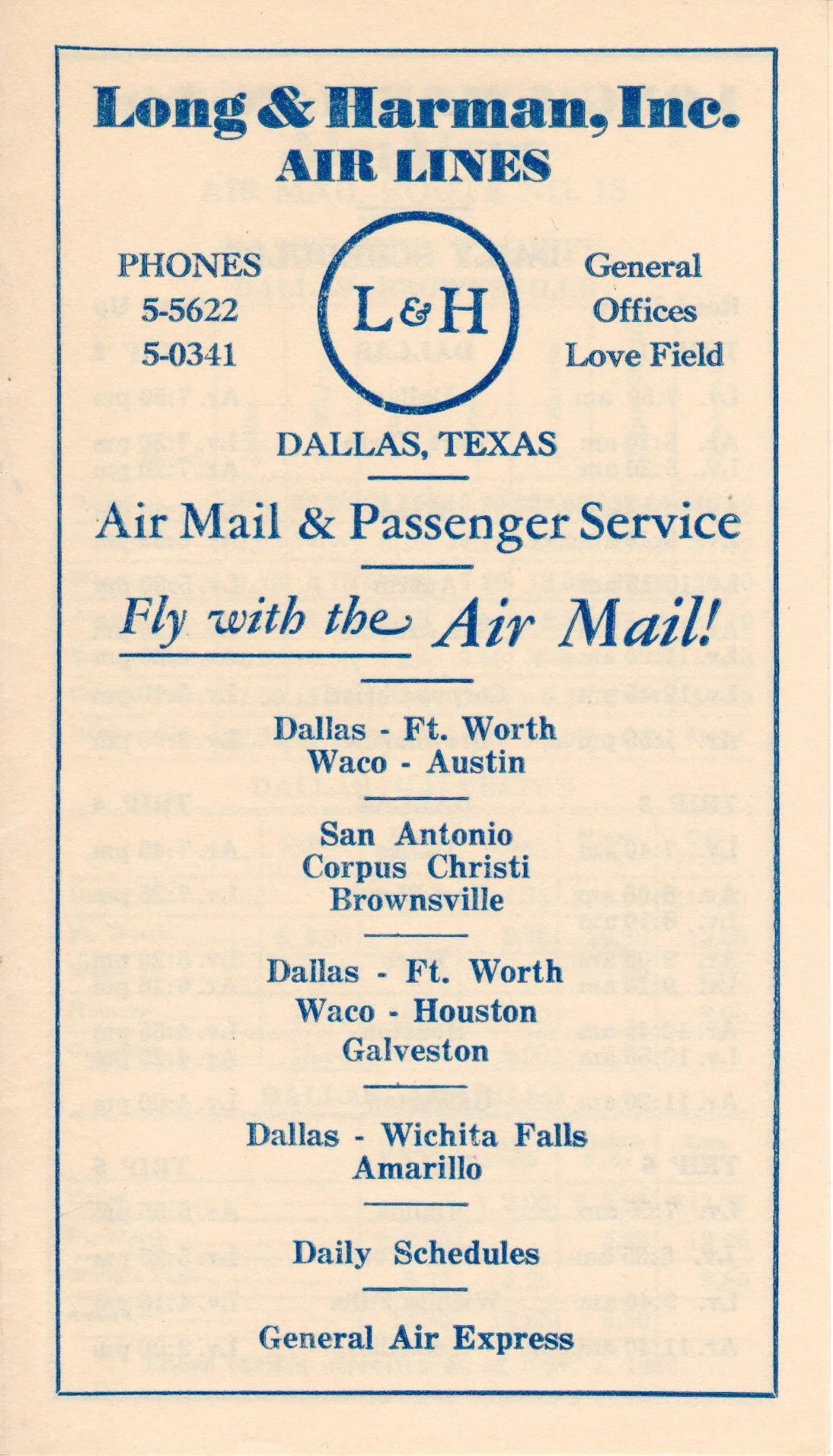
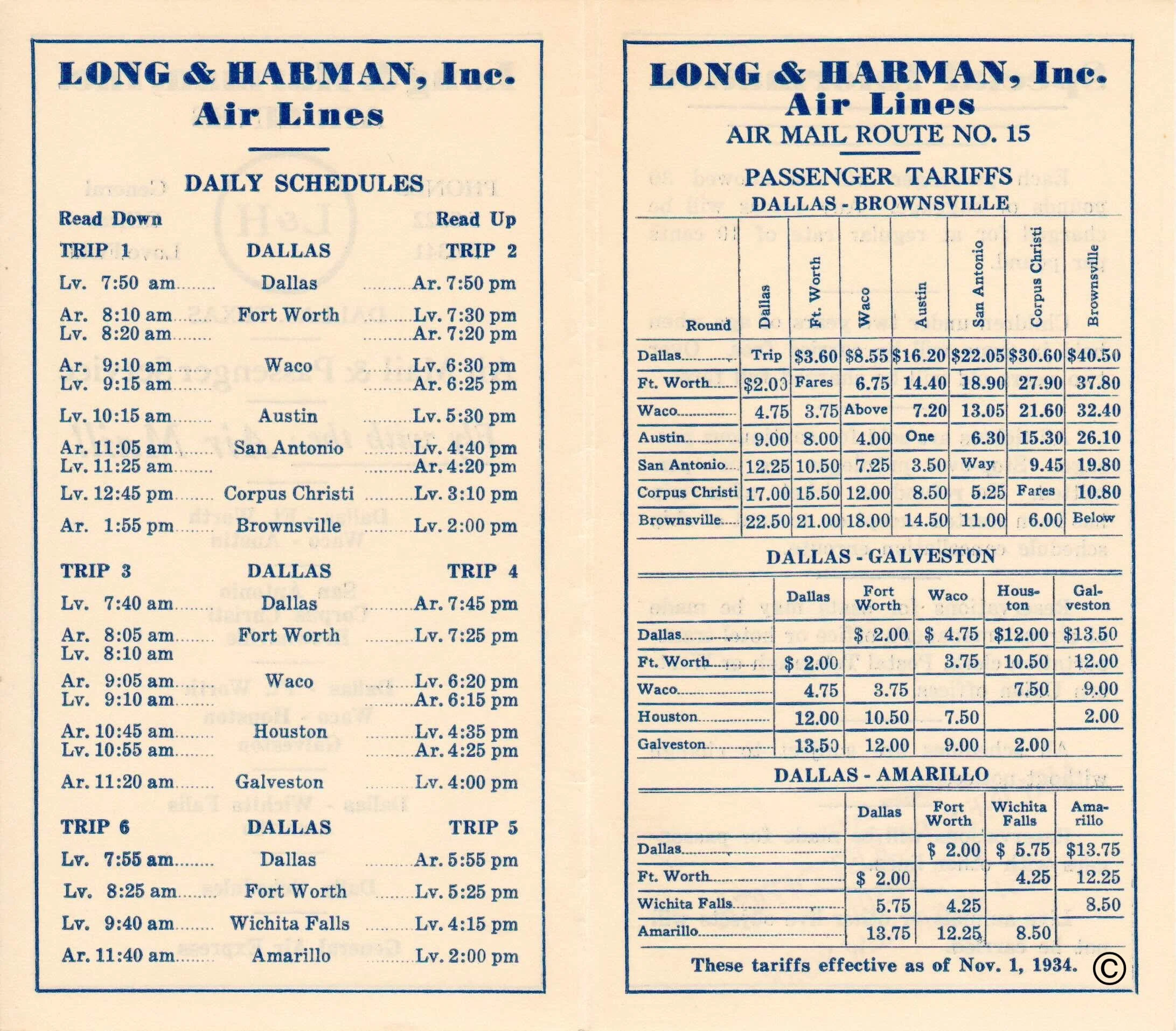
Purchases Dallas-based Long and Harman Airlines with Braniff as surviving carrier.
Photo: Front cover of Long and Harman Airlines Domestic Timetable dated Nov 1, 1934, the last prior to the merger with Braniff Airways. Copyright, Braniff Airways, Incorporated
BRANIFF AIRWAYS IN 1935
January 1, 1935
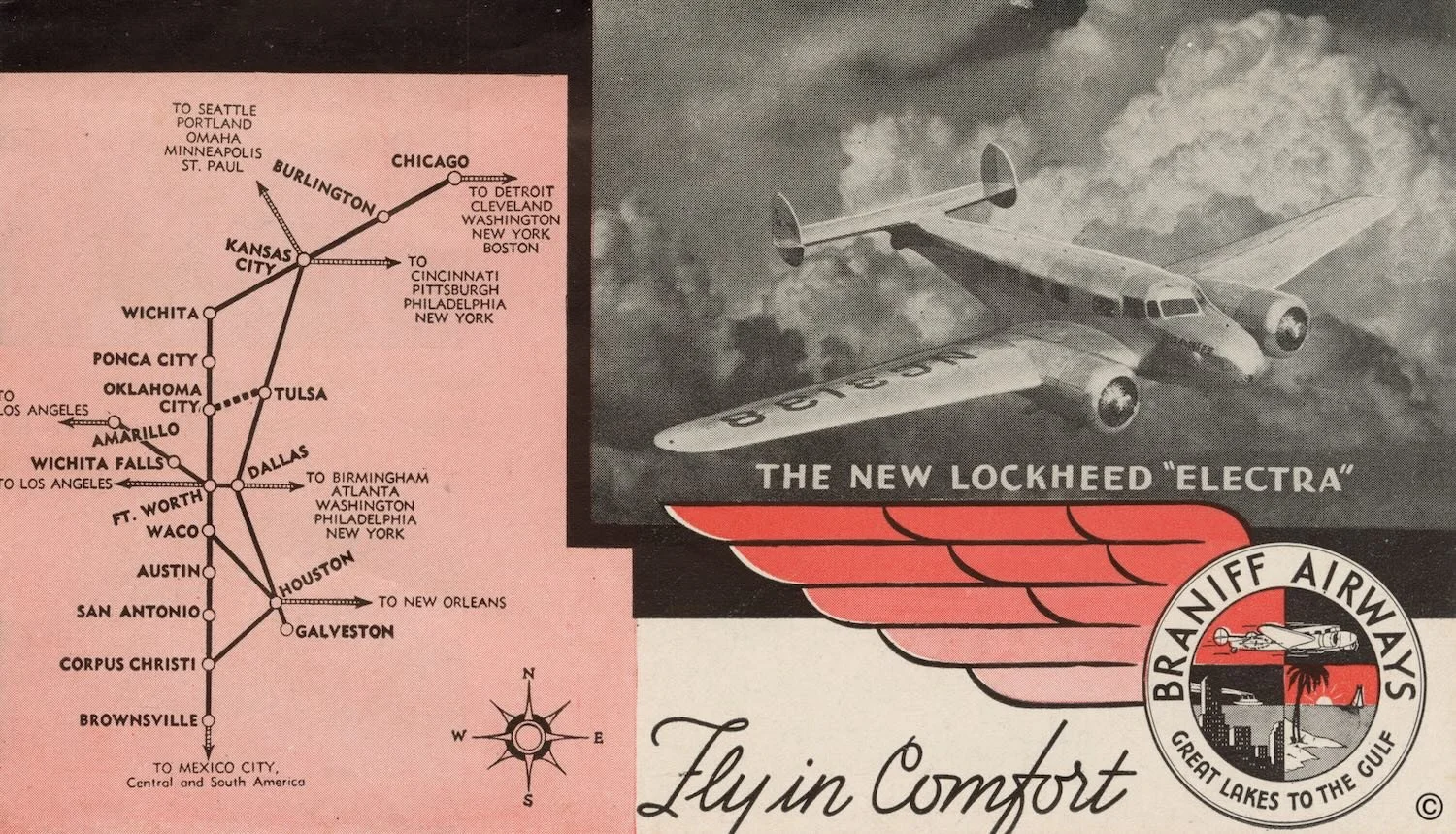
Merges with Long and Harman Airlines and begins service over Air Mail Route AM-15 from Dallas to Brownsville. Braniff adopts the new slogan “From Great Lakes to the Gulf”. Fifteen cities are now served including Chicago, Kansas City, Missouri; Wichita, Kansas; Oklahoma City, Oklahoma; Dallas, Amarillo, Wichita Falls, Ft. Worth, Waco, Austin, San Antonio, Houston, Galveston, Corpus Christi and Brownsville, Texas.
Photo: Long and Harman Domestic Timetable dated November 1, 1934. Copyright, Braniff Airways, Incorporated
March 30, 1935
First of seven 10-passenger Lockheed L-10A Electra twin-engine airliner delivered from Lockheed Plant at Los Angeles, California, to Braniff’s Base at Dallas Love Field by Braniff Airways Chief Pilot Ray Carrol Shrader
April 17, 1935
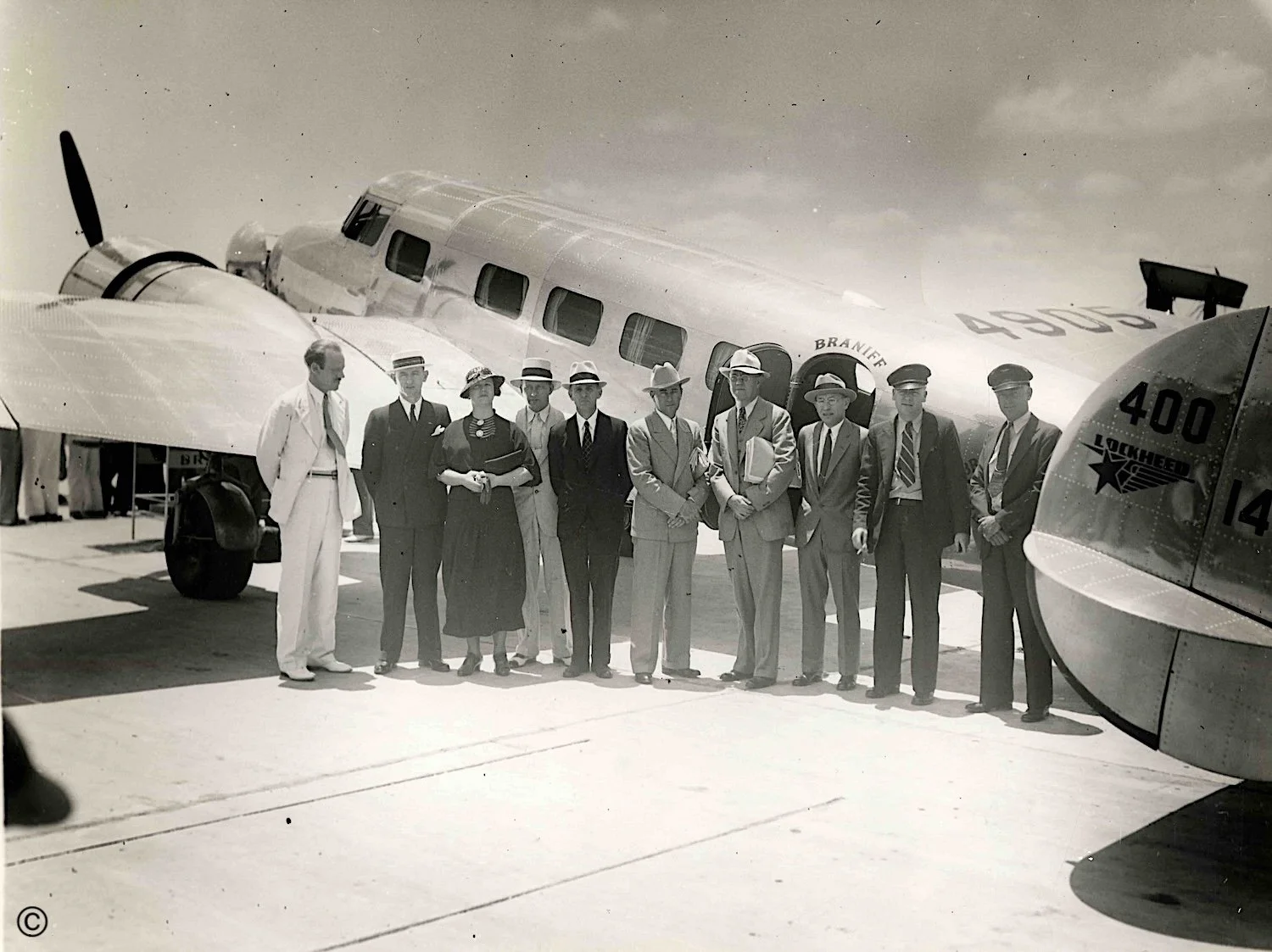
Inauguration of Braniff’s first twin-engine airliner, Lockheed L-10A Electra, service between Dallas and Corpus Christi.
Photo: Braniff Airways first Lockheed L-10A Electra registered as NC14905 is parked on the ramp at Brownsville Municipal Airport on April 17, 1935, after completing the Airline’s first scheduled flight with the new twin-engine aircraft. The big Electra, painted in the 1935 Red and Blue B Liner Color Scheme, was flown on its first by Captain R. V. Carleton, second from far right and Captain Ray Carrol Shrader, far right along with a planeload of inaugural passengers. Copyright, Braniff Airways, Incorporated

July 1, 1935
Inauguration of first Braniff passenger service at Wichita, Kansas. The new service was operated using Braniff's new and luxurious Lockheed L-10A 10-passenger airliner. A year earlier on June 15, 1934, Braniff began serving Wichita with mail and express cargo on its mail route between Oklahoma City and Chicago, which began on May 7, 1934.
Photo: Braniff Airways Terminal Hostess Miss Roberta Johnson is helping passengers at Wichita Municipal Airport in the early 1950s. Wichita became a significant Braniff station that offered passengers service from the Great Lakes and Rocky Mountains to the Gulf Coast. Copyright, Braniff Airways, Incorporated
September 15, 1935
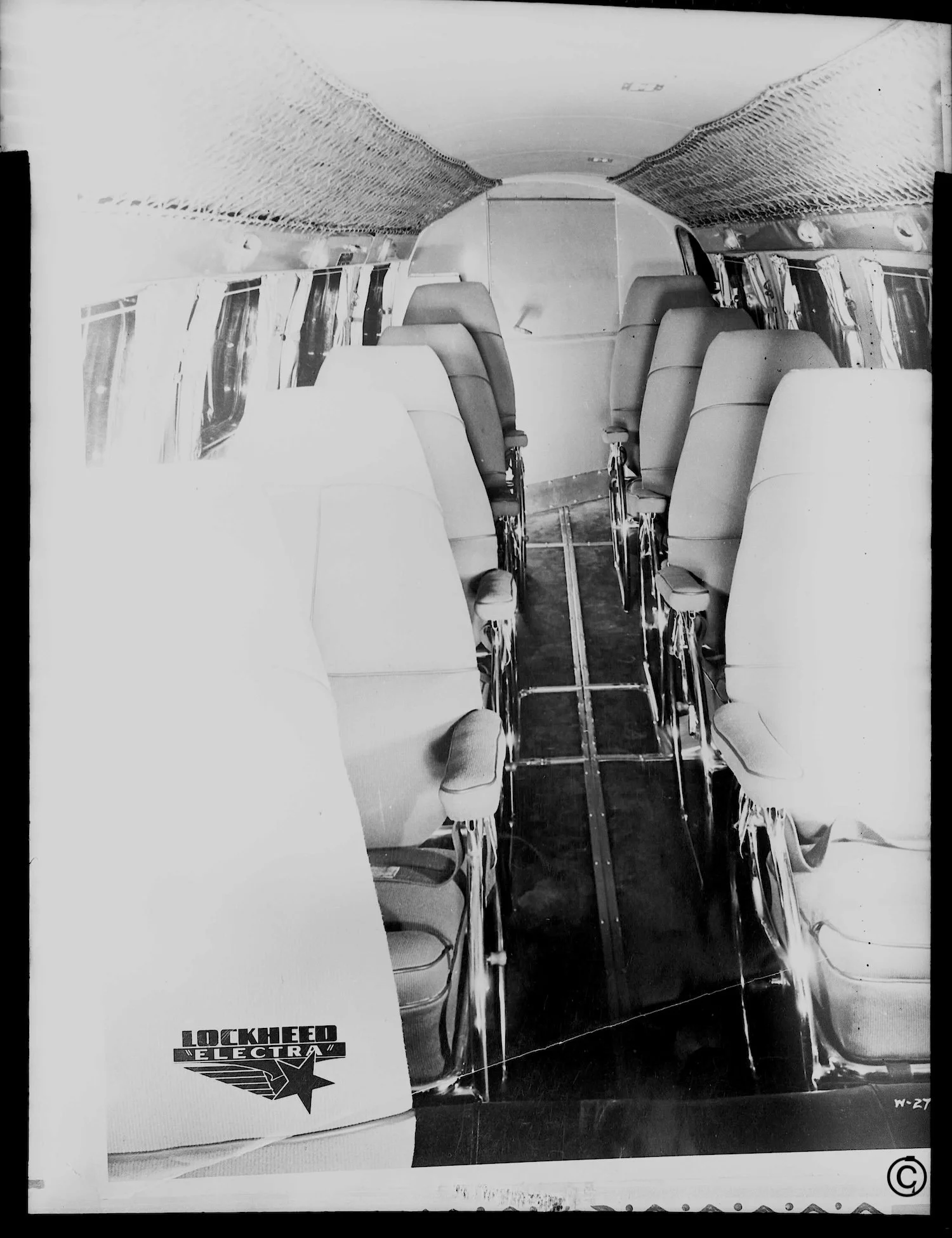
First Braniff inflight meal served by copilot in a cardboard box aboard the Lockheed L-10A Electra between Brownsville and Corpus Christi and Tulsa and Kansas City.
Photo: The plush interior of the new Lockheed L-10A features big comfortable seating and a wide center aisle. Copyright, Braniff Airways, Incorporated
December 17, 1935
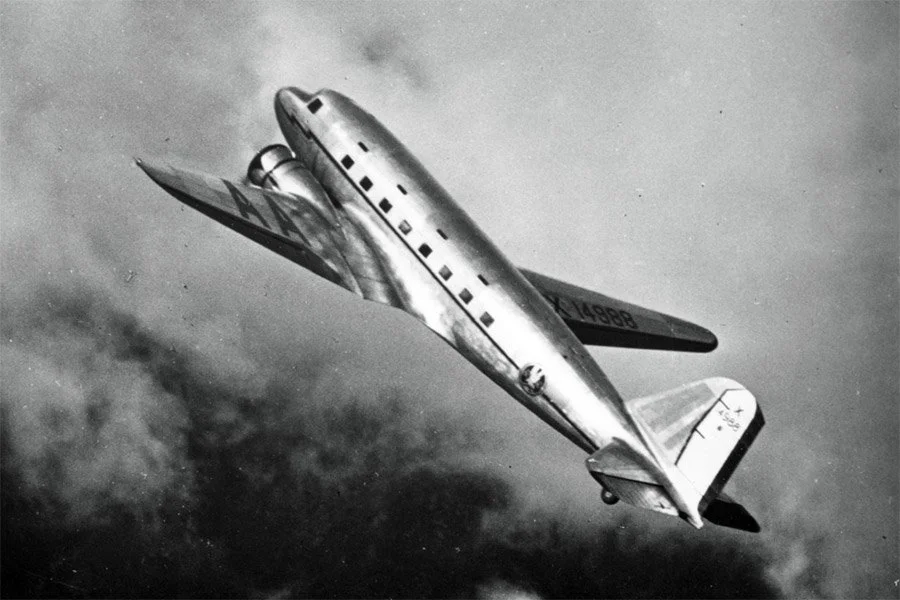
Douglas DC-3 twin-engine airliner makes first flight at Douglas Plant, Santa Monica, California. Specifically, the Douglas Sleeper Transport prototype took to the skies with Captain Carl Cover in command as Chief Test Pilot for Douglas Aircraft Company. The big airliner departed from Clover Field at Santa Monica, California.
Braniff began scheduled service with the DC-3 between Dallas Love Field and Amarillo, Texas, on February 3, 1940. By mid-1940, Braniff became an all Douglas aircraft airline by operating only Douglas DC-2 and DC-3 airliners. The DC-3 served Braniff faithfully for the next 21 years until retirement from scheduled service in April 1960.
Photo: Douglas Aircraft Company, Copyright
BRANIFF AIRWAYS IN 1936

January 1, 1936
Braniff’s fleet consisted of 7 Lockheed L-10A Electras, 4 Lockheed Vegas, 2 Ford Trimotors and 1 Stinson Reliant.
Photo: A Braniff Airways Lockheed L-10A is parked on the ramp at Dallas Love Field in 1935. The terminal was located on the north end of the airport along Love Field Drive. This building survives today and is used as the airport fire station. Copyright, Braniff Airways, Incorporated

February 1, 1936
Braniff inaugurates new Railway Express agency contract service for door-to-door package service. The REA operated from 1917 to 1975, and was an early UPS/Fed Ex type of package service. Note the Airmail 9 and 15 are scripted on the nose of the Electra.
Photo: A Braniff Lockheed L-10A Electra registered as NC14940 is parked on the maintenance ramp at Dallas Love Field in 1936. Copyright, Braniff Airways, Incorporated
March 1, 1936
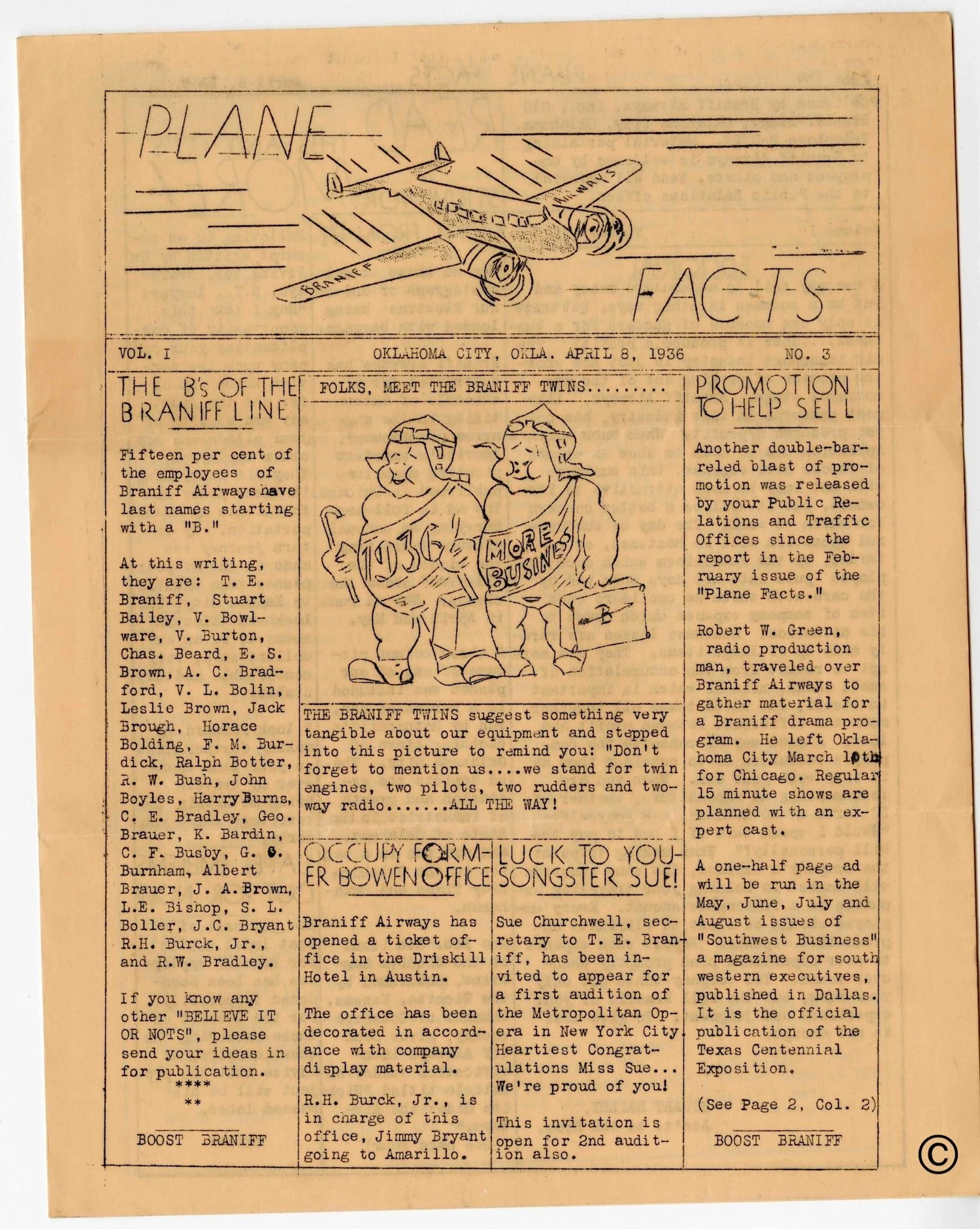
First employee newsletter dubbed Plane Facts debuts. Plane Facts featured a cover made from medium brown construction paper and was produced in mimeograph form. The Public Relations Office at the Oklahoma City Headquarters building on 324 North Robinson was charged with the editing of Plane Facts
BRANIFF AIRWAYS IN 1937
March 17, 1937
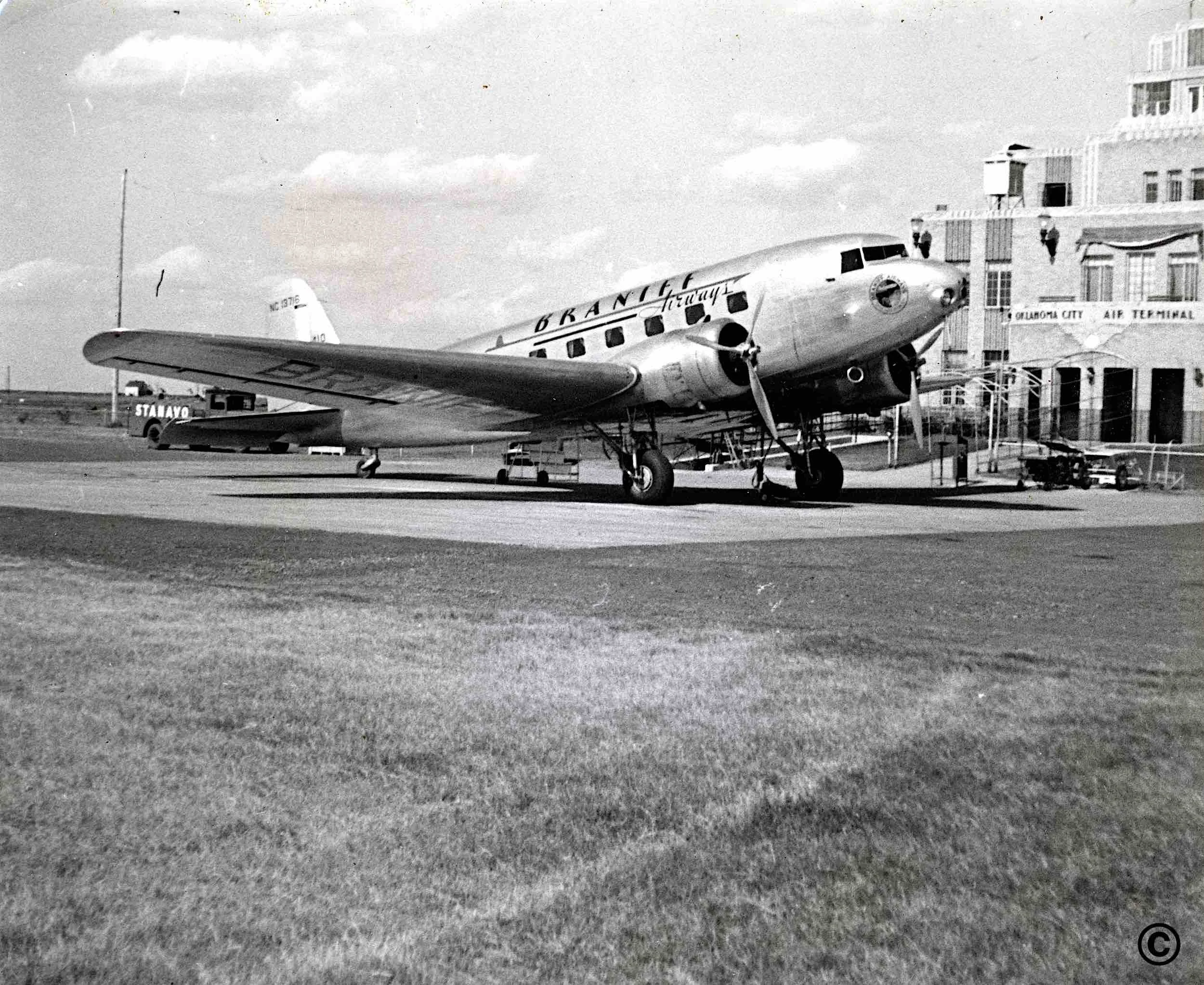
Five Douglas DC-2 twin-engine 14-passenger airliners were acquired from TWA to supplement the Electras between Chicago and Brownsville.
Photo: Braniff Airways, Incorporated, Douglas DC-2-112 B-Liner registered as NC13716 is parked on the ramp at Oklahoma City Will Rogers Airport in 1937 . Ship NC13716 is painted in the 1935 Blue and Red B-Liner Color Scheme and it remained in that color during service with the Oklahoma City-based trunk carrier. Braniff purchased its DC-2s from Transcontinental and Western Airlines on March 17, 1937, with all delivered between June 1937 and November 1938. Copyright, Braniff Airways, Incorporated
April 1, 1937
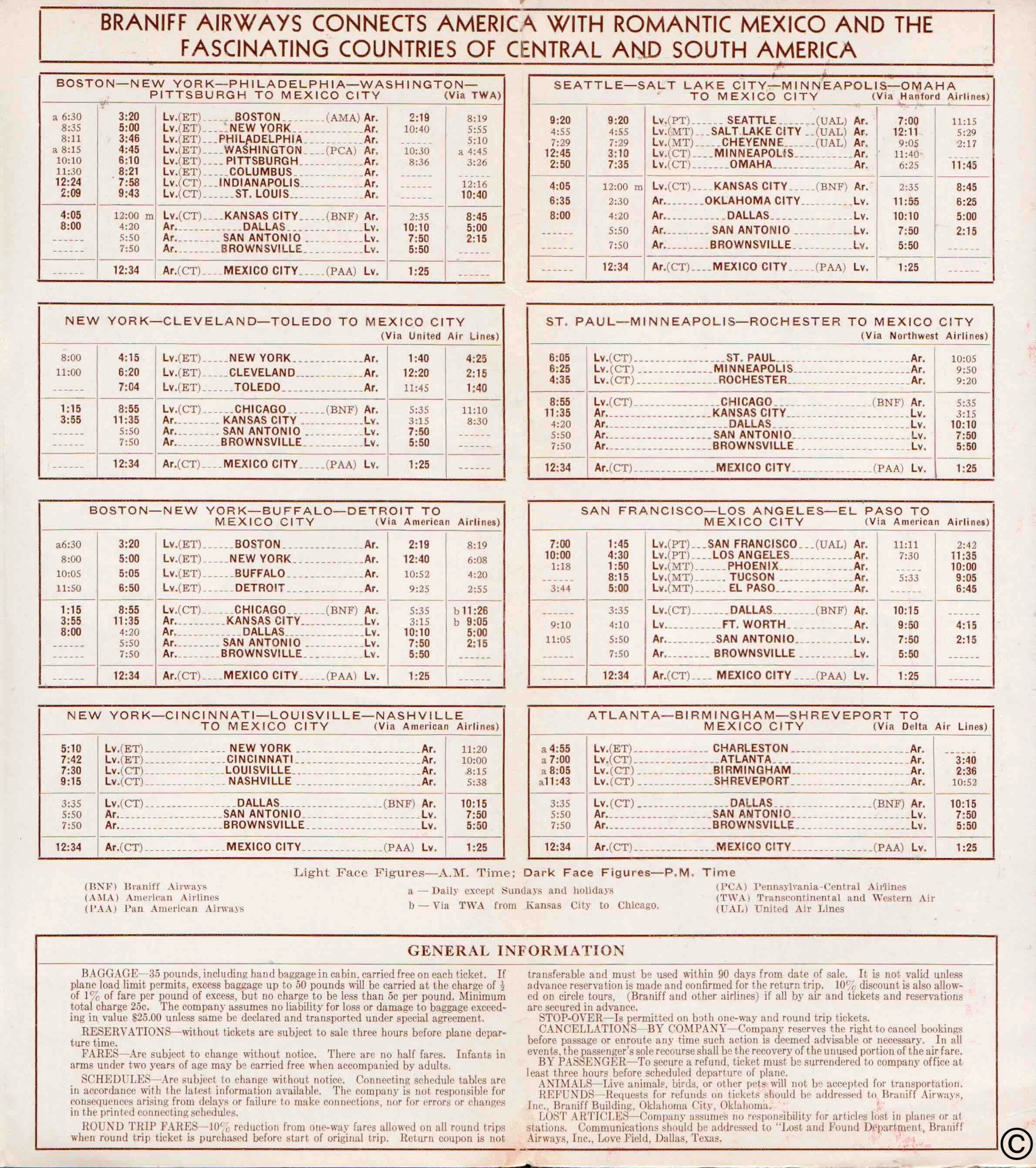
New Interchange Service with United Airlines from Chicago to Newark enables overnight service from Newark to Mexico City via United, Braniff and Pan American
June 1, 1937
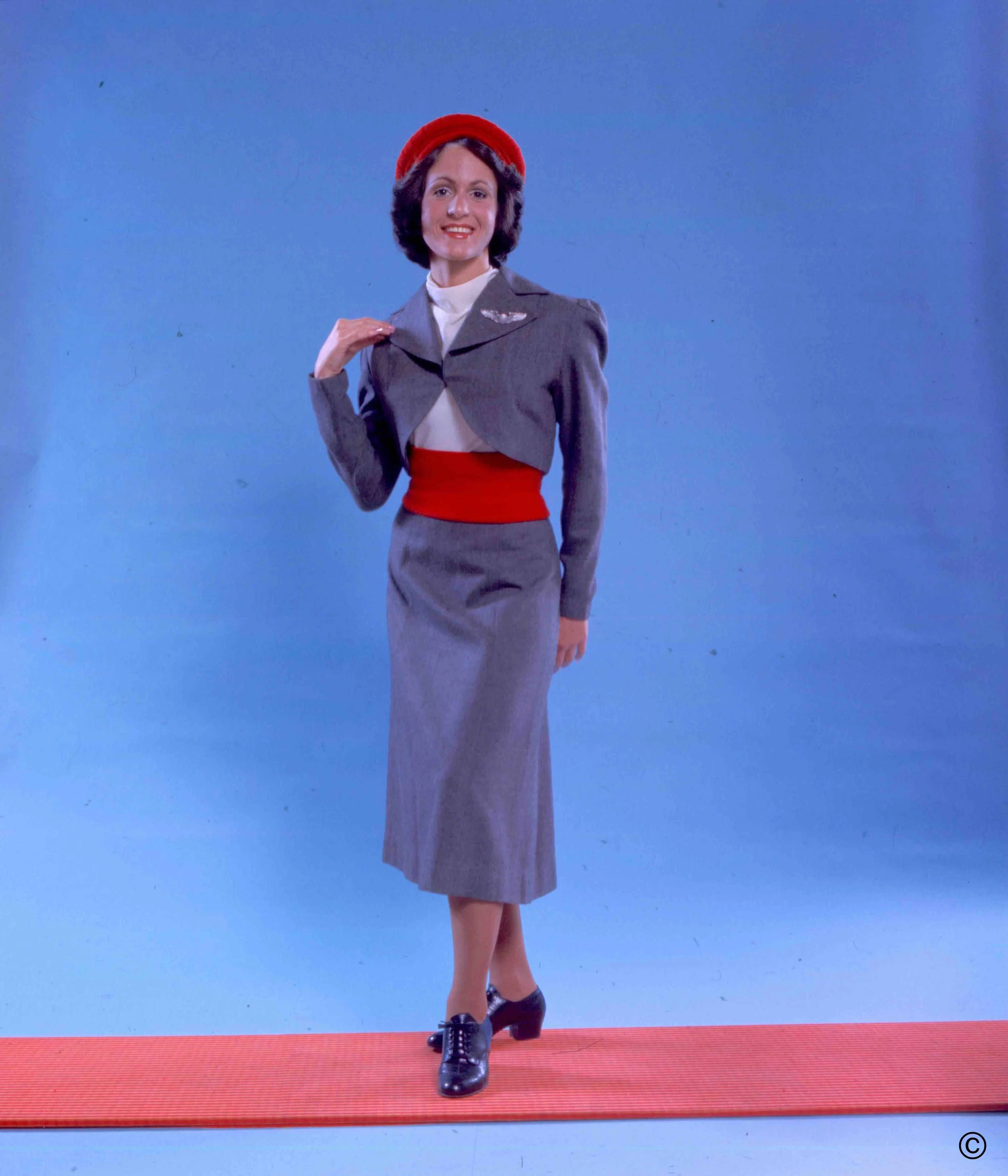
Braniff hires its first cabin attendants called hostesses. While ten went through training, only six met the stringent standards and graduated.
Photo: The first Hostess uniform was called The Bolero and featured a distinctive Latin flair in its design. The uniform consisted of a Dark Blue Wool Skirt and matching Dark Blue Bolero Cut Jacket. The jacket and hat were trimmed in red sash and the outfit was worn with dark leather shoes. The uniform was upgraded with a new pill box hat in dark blue with matching sash. Copyright, Braniff Airways, Incorporated
June 12, 1937
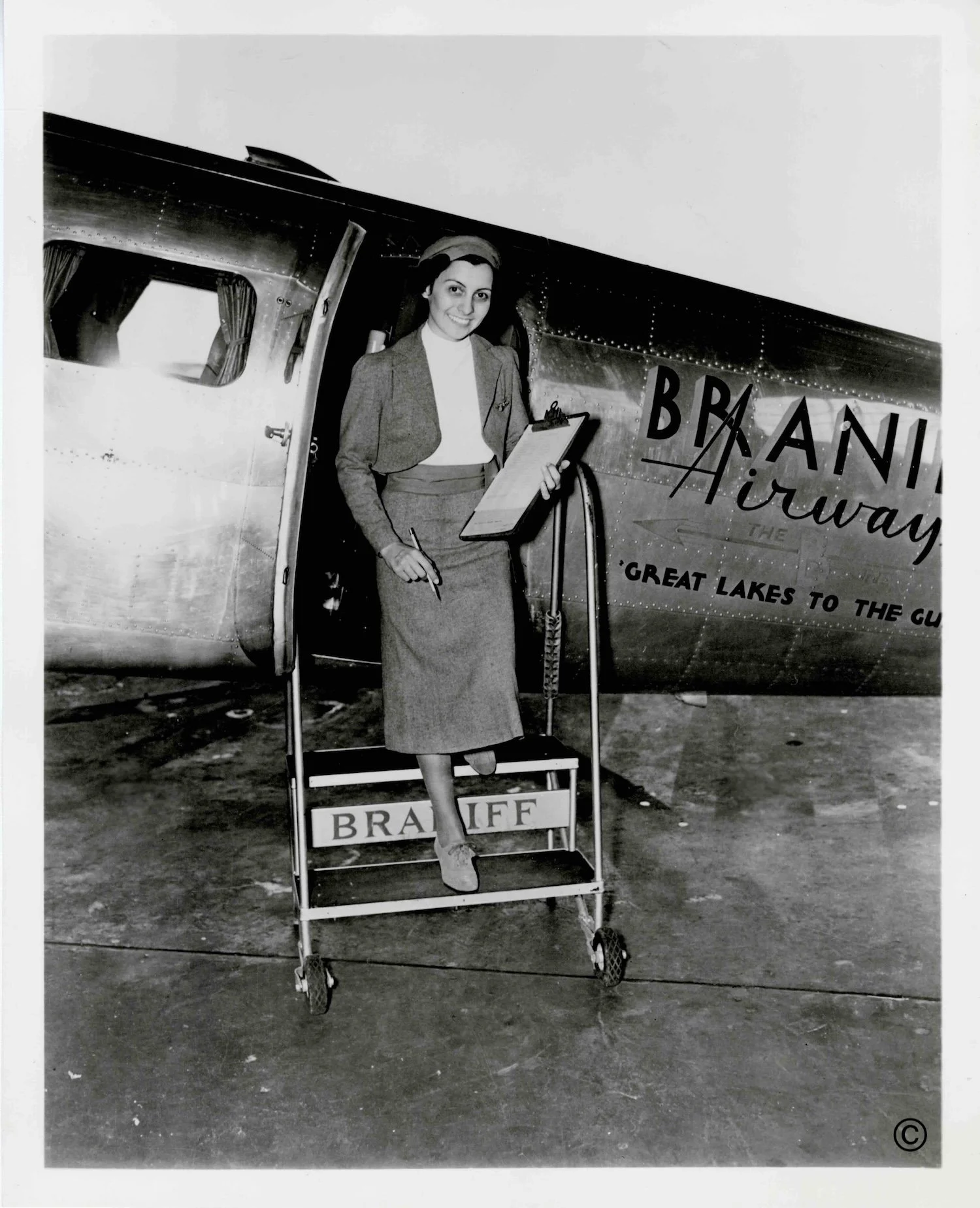
First Braniff Hostesses begin inflight service on 14-passenger Douglas DC-2 twin-engine aircraft.
Photo: Braniff initially hired four Hostesses that were quickly followed by another four. The original Hostesses were Rebecca Garza (pictured at entrance to Braniff L-10A Electra aircraft), Louise, Zarr, Irene Martinez, Lucile Behl, Iris Gillis, Vera Campbell, Polly West, Maria Romero, Margie McKay, and Ruth Joseph.
Braniff's first Chief Hostess was Violet Burton who conducted Braniff's first Hostess class beginning in May, 1937. Requirements to become a Braniff Hostess were ability to understand Spanish, two or more years of university level education, a pleasant disposition and ability to deal with the public on a daily basis. Hostess applicants must have a proper appearance and be of an age between 21 and 26, weigh 110 to 118 pounds, possess a height of 5 feet to 5 feet 4 inches, and the applicant must not be married. Copyright, Braniff Airways, Incorporated

June 12, 1937
First Douglas DC-2 service inaugurated between Dallas and Brownsville and then between Dallas, Kansas City and Chicago. Service was quickly extended north from Love Field to Kansas City and Chicago, prompting the Airline to adopt its iconic "From the Great Lakes to the Gulf" slogan.
Photo: A luxurious Braniff DC-2 is arriving at Dallas Love Field on inaugural day June 12, 1937. Copyright, Braniff Airways, Incorporated
July 1, 1937
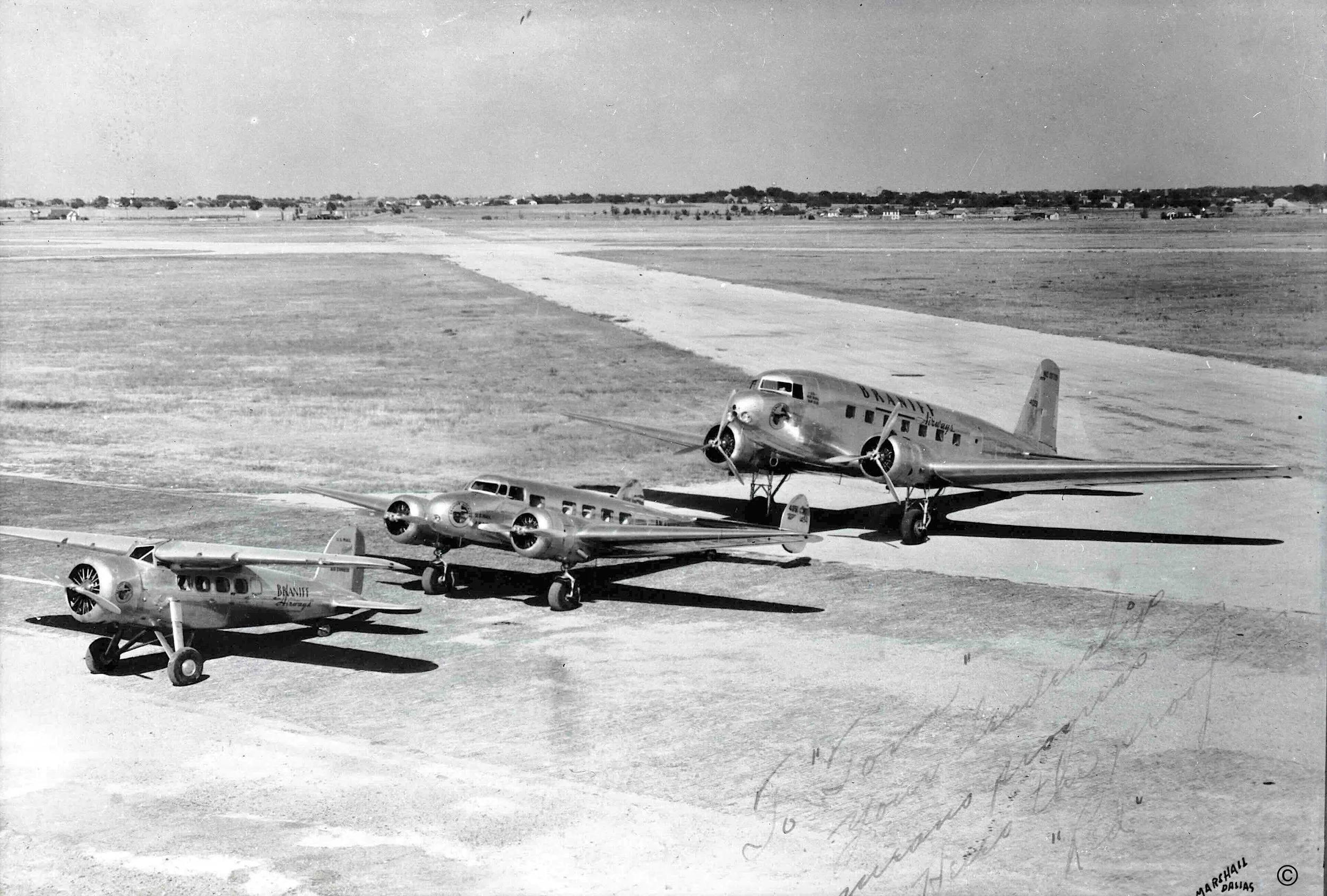
Last Braniff flight flown with the venerable Lockheed Vega airliner on a flight from Dallas to Amarillo.
Photo: Photo: All three of Braniff's luxury airliners paused for a brief moment for this historic photoshoot at the Airline's Oklahoma City headquarters on July 15, 1937, to honor the last flight of Braniff's Lockheed Electra fleet two weeks earlier on July 1, 1937. From left to right, the last Lockheed Vega in Braniff's fleet that flew the last Vega flight between Dallas and Amarillo and Dallas is registered as NC14941 and dubbed Silver Streak because of the all natural metal finish and high speed of the Vega; Lockheed Electra L-10A registered as NC14941 and finally the new Douglas DC-2 Skyliner registered as NC13719.
The inscription on the photograph is to Mr. Thomas Elmer Braniff from Captain Red McDonald. Captain McDonald praised Mr. Braniff for his visionary guidance of the Airline.
Copyright, Braniff Airways, Incorporated
BRANIFF AIRWAYS IN 1938
June 20, 1938
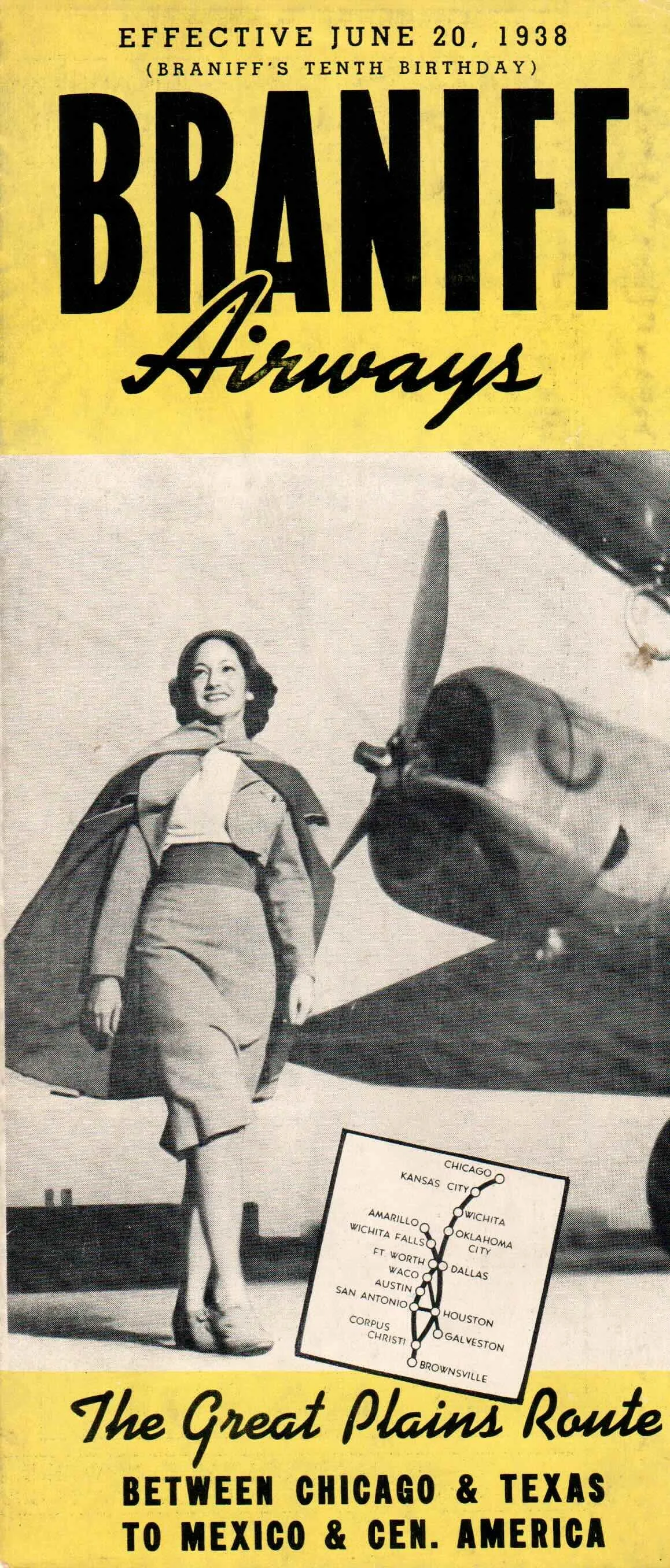
Ten long and hard years yielded an amazing airline on Braniff’s 10th Anniversary. The company operated 2,963 route miles and flew 8,700 miles daily on 20 schedules to 15 cities
BRANIFF AIRWAYS IN 1939
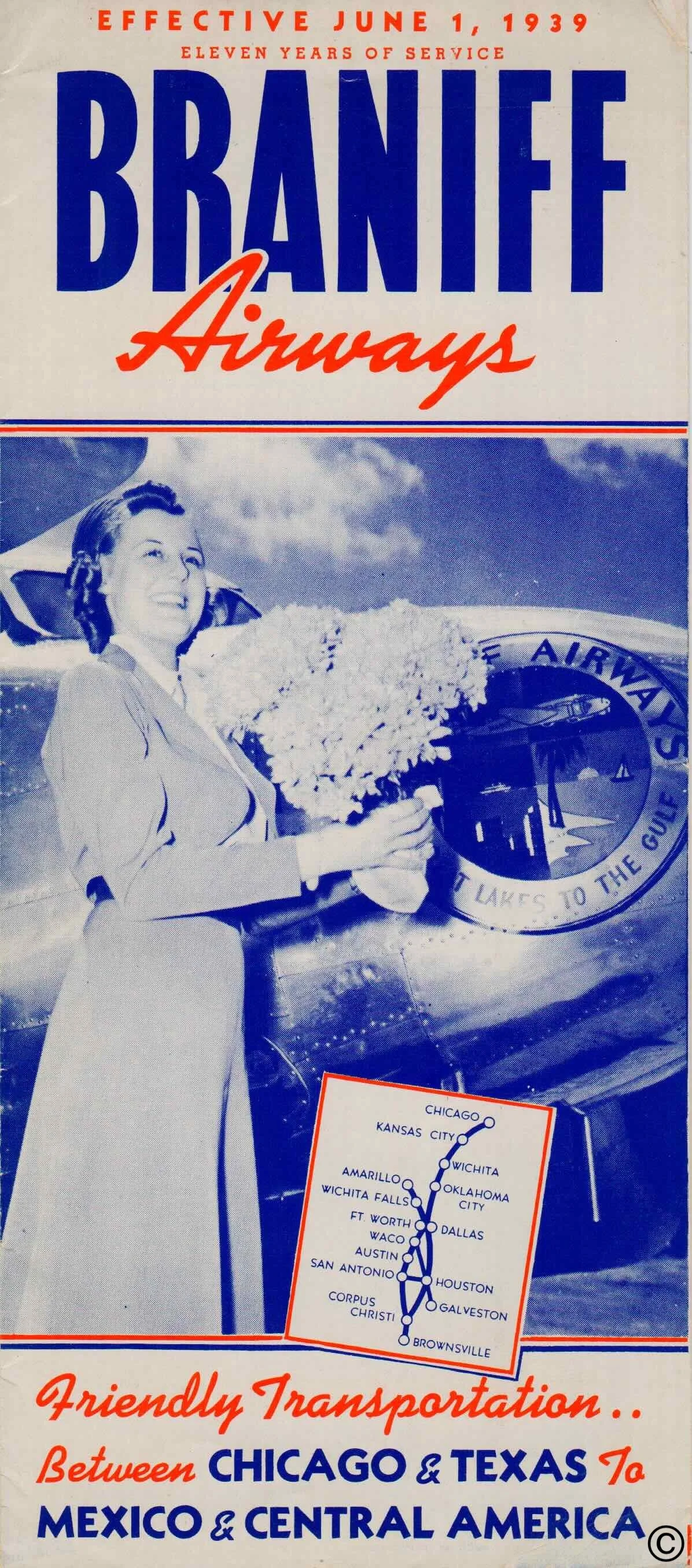
June 20, 1939
The celebration of Braniff’s 11th Anniversary found the Airline operating a fleet of Douglas DC-2 twin-engine airliners flying nearly 10,000 miles daily. In June 1939, Braniff flew 1,626,592 Revenue Passenger Miles, which was an increase of 63 percent over the same period in June 1938, when the company flew 997,599 RPMs
August 30, 1939
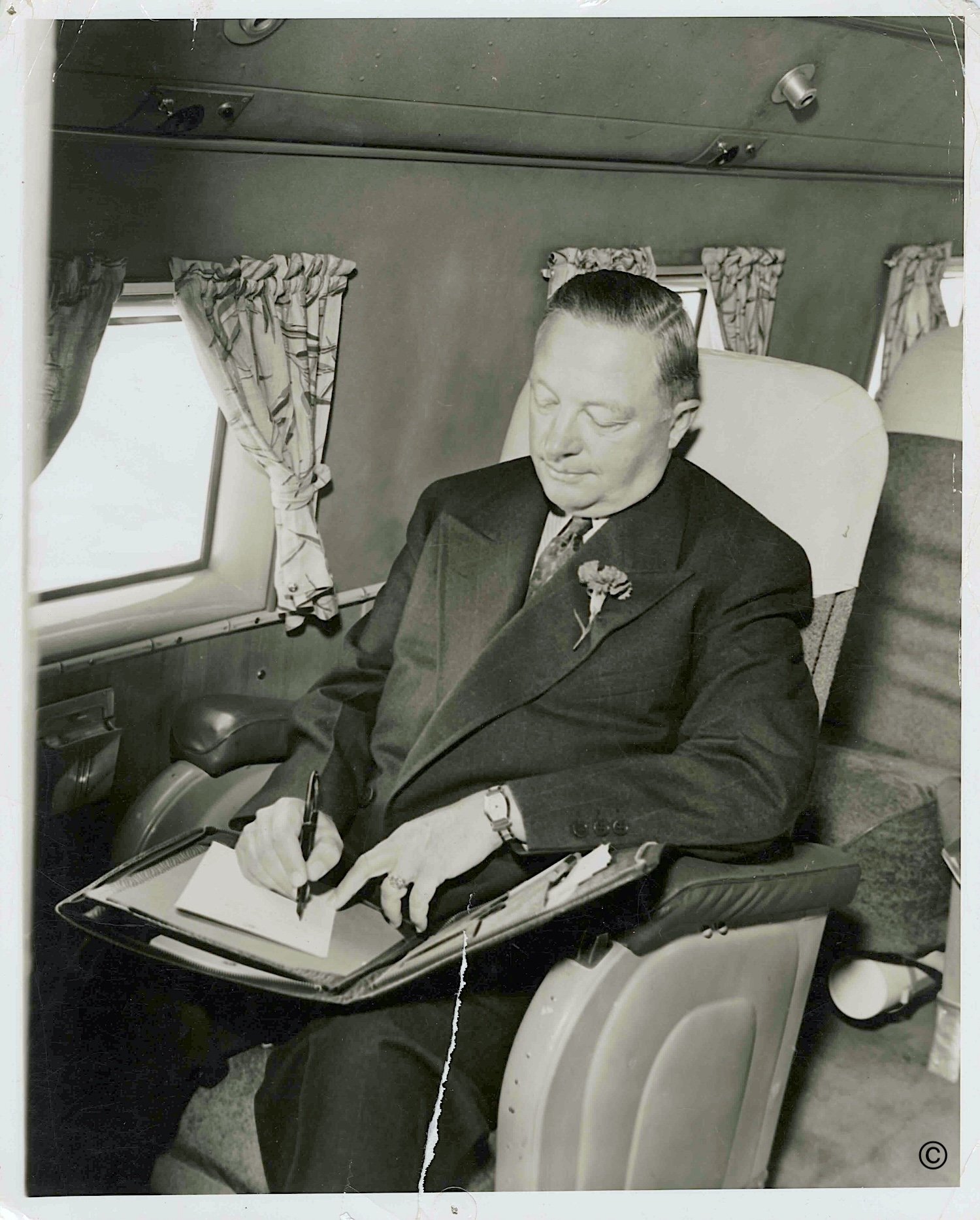
President Thomas Elmer Braniff announces an order for four Douglas DC-3 Super B-Liners capable of carrying 21-passengers in cabin class comfort with a crew of three. This order increased the fleet to 16 aircraft. The DC-3 revolutionized air travel just as the Boeing 707 did only twenty year later.
Photo: Mr. Braniff takes a moment to review company documents while traveling aboard the company’s brand new Douglas DC-3 airliner dubbed “The Great Ship”.
Copyright, Braniff Airways, Incorporated
December 14, 1939
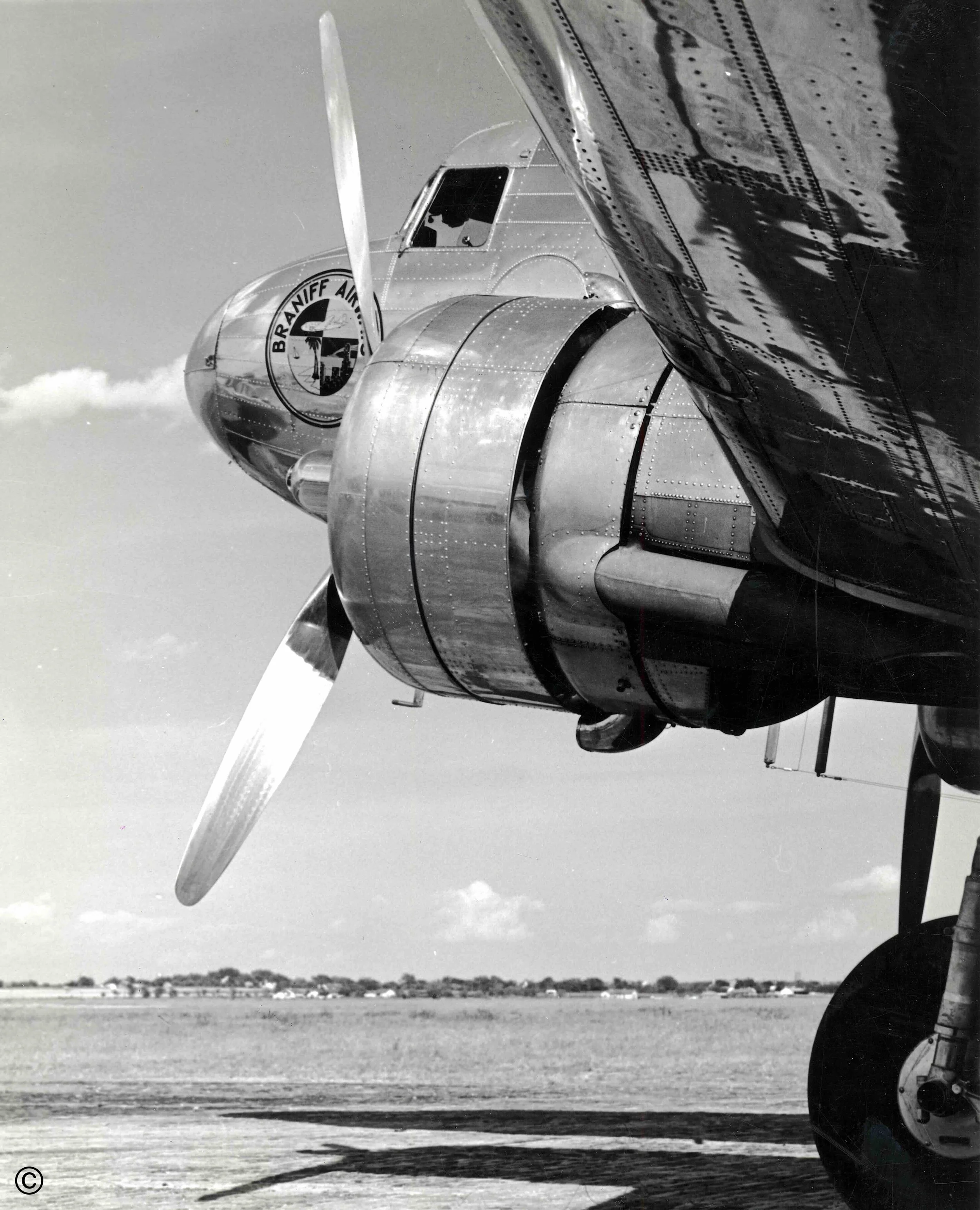
First Douglas DC-3 registered as NC21773 is delivered to Braniff at Douglas Plant in Santa Monica, California.
Photo: A dramatic photo of Braniff’s newly delivered DC-3 registered as NC21773 at Santa Monica, California.
Copyright, Braniff Airways, Incorporated
December 15, 1939
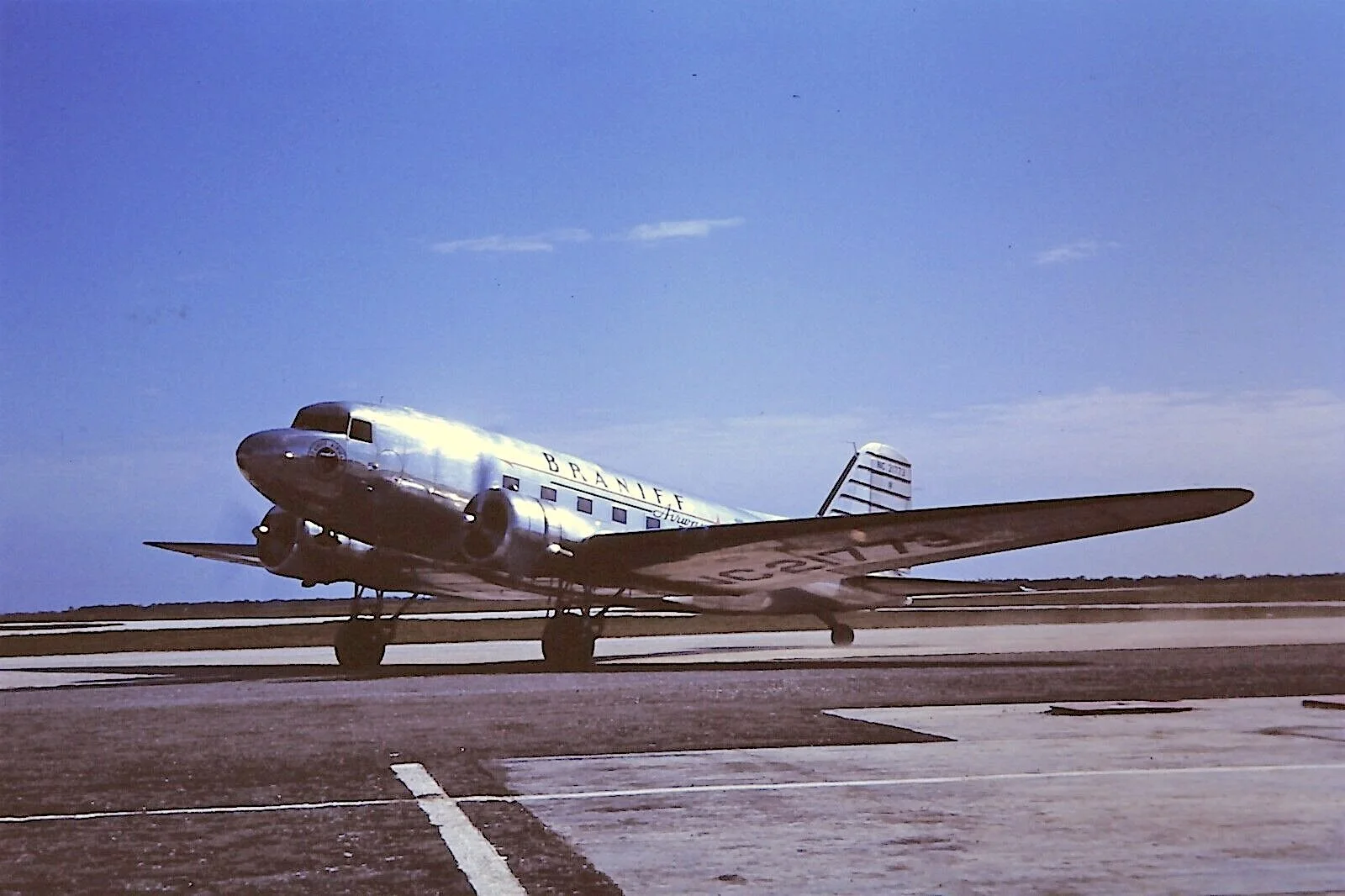
First Douglas DC-3 registered as NC21773 arrives in Oklahoma City, as shown in the photo, after delivery from Douglas Aircraft Company.
Copyright, Braniff Airways, Incorporated
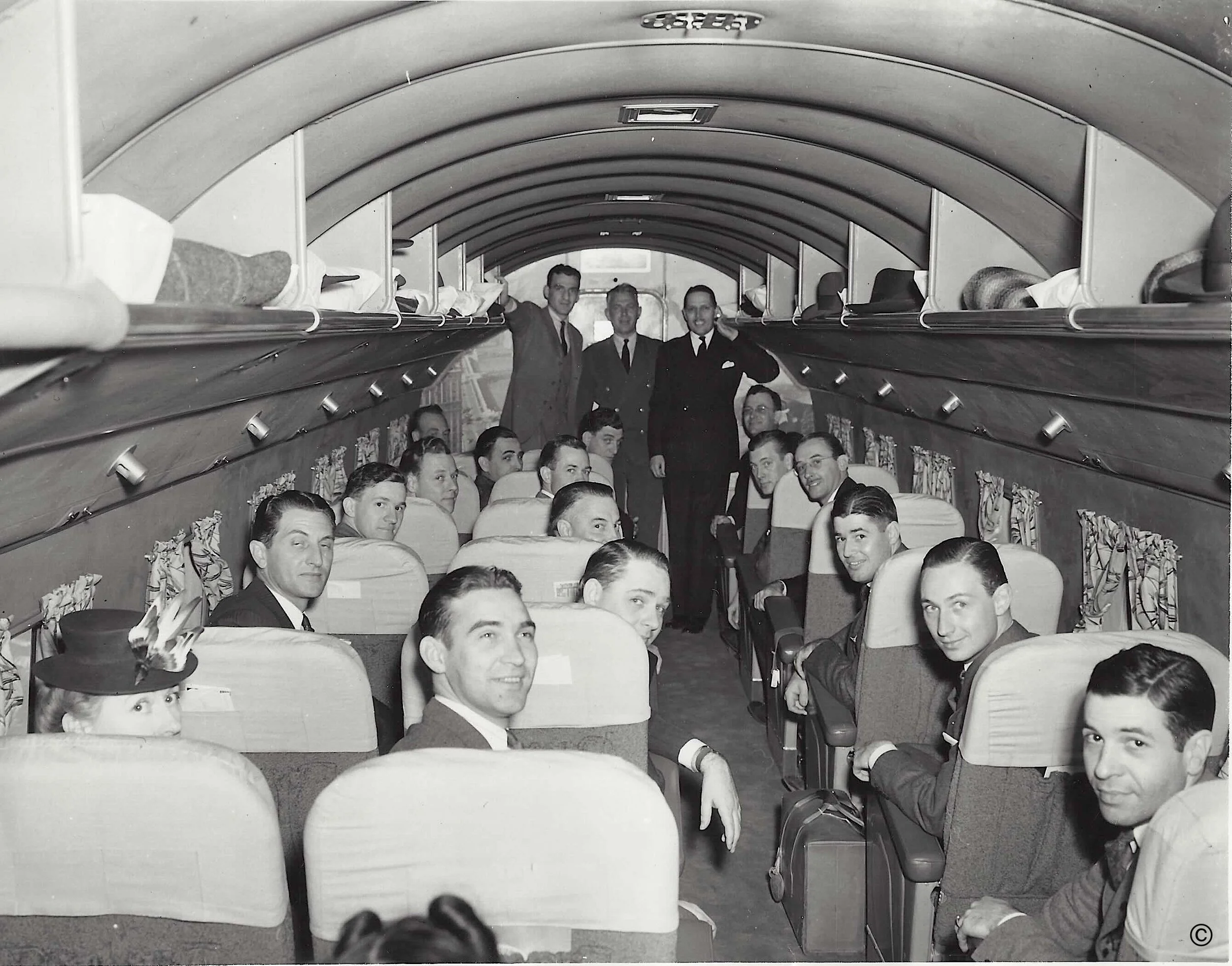
December 17, 1939
First airborne sales meeting held aboard new Douglas DC-3 and hosted by Braniff Vice President Charles Edmund Beard